
Dhiraj Kandel
Managing DirectorSchedule a free consultation with our expert counselors to discuss your study
The essentials at a glance
You can study in the USA from Nepal after +2 for a bachelor's or community college, or after a bachelor's for a master's. Many universities ask for a +2 GPA of about 2.5 to 3.0 and an English score such as IELTS 6.0 or Duolingo. You need an I-20 from your university and money for at least your first year. The first year at a public university usually costs about $27,000 to $42,000. For the F-1 visa you pay two government fees and attend an interview in Kathmandu.
Main points from this page
After +2 you can start a 4-year bachelor’s degree or a 2-year community college course in the USA. After a bachelor’s, most Nepali students choose a master’s of 1.5 to 2 years.
Most Nepali students go to the USA at one of two points. After +2 (what India calls 12th), a bachelor’s degree takes 4 years, and the first year is broad, so you can try subjects before you choose your major. Another way in is a community college in the USA. You study 2 years there at a lower fee, then move to a university for the last 2 years.
If you already have a bachelor’s from Nepal, a master’s in the USA usually takes 1.5 to 2 years. Our guide to a master’s in the USA from Nepal covers entry and costs. Strong students can apply straight to a PhD after a bachelor’s, which is common in the USA and often comes with funding.
| Level | Who it suits | Usual length |
| Community college (associate degree) | +2 students who want lower fees first, then a transfer | 2 years |
| Bachelor’s degree | +2 students who meet the university’s marks and English score | 4 years |
| Master’s degree | Students with a bachelor’s the university accepts | 1.5 to 2 years |
| PhD | Students with strong results and research interest | 4 to 6 years, often funded |
From 15 September 2026, F-1 students are admitted until the end date on their I-20, for up to 4 years, not for as long as they study.
This comes from a DHS rule on a fixed period of admission published in July 2026. If your course runs longer than 4 years, or you need more time, you apply to USCIS to extend your stay. After your course ends you get 30 days to leave, change status or start practical training. So plan a course you can finish on time, because a delay for weak results is usually not a good reason for more time.
Two other points matter for your visa. The U.S. Embassy in Nepal visa page asks F-1 applicants to set all their social media accounts to public before the interview. Nepal is not one of the 39 countries limited by Presidential Proclamation 10998, so Nepali students can still get F-1 visas. In October 2026 DHS also proposed new fees for practical training after study, but that is only a proposal for now.
Your +2 or bachelor’s marks decide where you can apply, and good marks also win scholarships. Check yours with our NEB GPA calculator.
At least your first year of tuition and living costs, as shown on your I-20. Check today’s rate with our USD to Rs forex converter.
Your passport, the I-20 from your university, the SEVIS fee receipt, the DS-160 form confirmation and your bank papers.
Nepali students choose the USA for its choice of courses, scholarships and assistantships, and up to 3 years of work after a STEM degree.
The USA has the widest range of universities and colleges of any study country, from large research universities to small colleges with small classes. That means there is usually a course and a price point for most +2 and bachelor’s students in Nepal. Many Nepali families also have relatives or friends in the USA, which helps in the first months.
The USA is not cheap, and the visa interview is short and strict. So the benefits below only help if your university, budget and study plan are realistic. Our page on reasons to study in the USA goes into each one.
You can start a bachelor’s without choosing a major on day one and switch later. Credit from a community college can count towards a university degree.
Many universities give merit scholarships to international students, and master’s and PhD students can apply for teaching or research assistant jobs that pay part of the fee.
F-1 graduates can work for 12 months on OPT, and STEM graduates can add 24 months more. ICE explains practical training.
Universities invest heavily in labs and research projects. Even bachelor’s students can join a professor’s research team, which helps for jobs and a later PhD.
Cities such as Dallas, New York and the Washington area have large Nepali communities. Our guide to the best cities to live in the USA compares them.
Still choosing a country? Our comparison of Australia vs Canada vs UK vs USA and our guide to Canada vs USA for Nepali students can help you decide.
Nepali students most often choose computer science and IT, data science, business and MBA, engineering, and nursing and health.
These courses lead to jobs in both the USA and Nepal, and many of them count as STEM, which gives the longer work time after study. Our list of courses in the USA for international students explains each one. Read more about computer science in the USA, data science in the USA and business administration in the USA.
Nursing is popular too, but it has extra licence steps after the degree, as our page on nursing courses in the USA explains. Our guide to the best subjects to study in the USA from Nepal compares more options. Whatever you choose, pick a course that fits your past study and your plan, because the visa officer will ask why you chose it.
You need an offer from a SEVP-certified school, good +2 or bachelor’s marks, an English score the school accepts, and money for at least your first year.
Each university sets its own marks, so requirements to study in the USA from Nepal change from one school to the next. Many bachelor’s courses ask for a +2 GPA of about 2.5 to 3.0, and many master’s courses prefer 3.0 or more. Our guide on how much GPA is required to study in the USA gives options for each GPA level, including a low one.
Many universities no longer require the SAT for a bachelor’s, but a good score can still help with scholarships. For a master’s, some business and engineering courses ask for the GRE or GMAT. Our page on eligibility to study in the USA lists the papers by level, from transcripts to recommendation letters.
A gap after +2 or your bachelor’s is usually fine if you can show what you did. Our guide on how much study gap is accepted in the USA explains how to present it. Only schools certified by SEVP can issue the I-20 you need for the visa, and you can check any school on the Study in the States school search.
Talk to a Goreto counselor about your course, budget and documents before you apply. Your first session is free.
4 years – the usual length of a US bachelor’s degree.
3 intakes – Fall, Spring and Summer.
2 + 2 – two years at a community college, then two at a university.
30 days – how early you can enter the USA before your course starts.
You can choose from public state universities, private universities and community colleges, and each has its own fees, entry level and scholarships.
Our list of universities in the USA for Nepali students has a profile for each one we cover. Very selective private universities include Harvard University, MIT and Stanford University. A few of them, such as Harvard and MIT, meet the full financial need of the international students they admit. So a strong student from Nepal should not rule them out on price alone.
Big city and state options include New York University, Columbia University and the University of California, Berkeley. Most Nepali students, though, study at state universities with lower fees and wider entry. Our guide to public vs private universities in the USA compares the two.
Community colleges cost less and accept a wider range of marks. Our list of colleges in the USA for Nepali students includes De Anza College, Foothill College, Santa Monica College and Miami Dade College.
You apply online to each university, or through the Common App for many bachelor’s courses, with your transcripts, English score, essays and recommendation letters.
Bachelor’s students often use the Common App, which sends one form to many universities. Master’s students usually apply on each university’s own website. Our guide on how to apply to study in the USA from Nepal goes through each document in order.
Most Nepali students apply to 4 to 6 universities: one or two ambitious choices, two good matches and one or two safer options. Some universities ask for your Nepal marksheets to be checked by a credential evaluation service, which takes a few weeks, so start early. Your essay and SOP for a USA student visa should tell the same story about your plan.
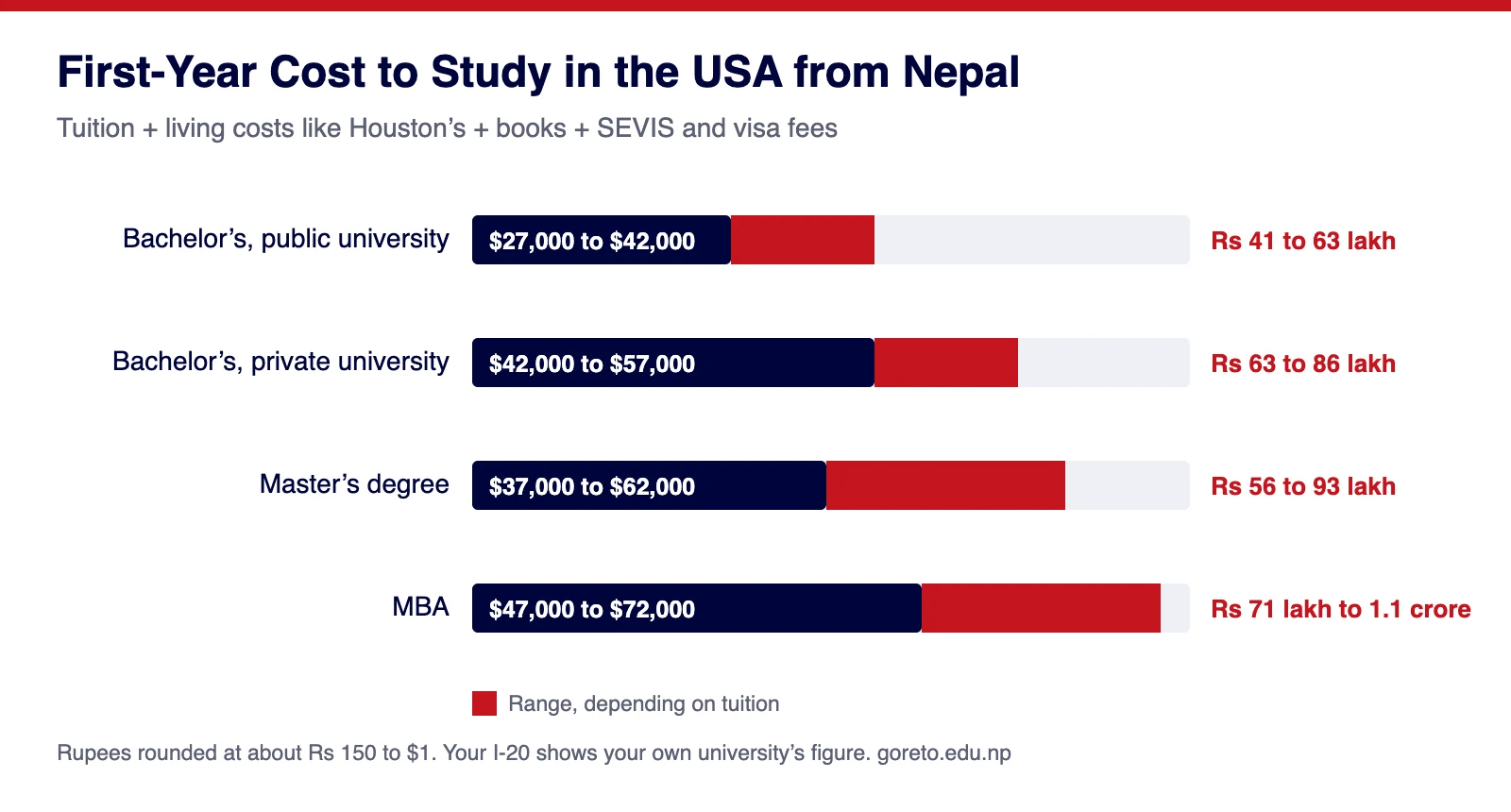
For most Nepali students, the first year at a public university costs about $27,000 to $42,000, which is about Rs 41 to 63 lakh.
That total covers tuition, living costs, books and the SEVIS and visa fees. Tuition is the part that changes most: public universities are cheaper than private ones, and community colleges are cheaper still. For living costs, the University of Houston I-20 page uses $15,060 a year plus $1,300 for books, and big coastal cities cost more.
The tuition ranges below come from our page on the total cost to study in the USA from Nepal, which breaks them down by level and course. Our guide to the cost of living in the USA covers rent, food and transport by city. Rupees are rounded at about Rs 150 to $1.
| Your plan | Tuition a year | First-year total | In Rs (about) |
| Bachelor’s, public university | $10,000 to $25,000 | $27,000 to $42,000 | Rs 41 to 63 lakh |
| Bachelor’s, private university | $25,000 to $40,000 | $42,000 to $57,000 | Rs 63 to 86 lakh |
| Master’s degree | $20,000 to $45,000 | $37,000 to $62,000 | Rs 56 to 93 lakh |
| MBA | $30,000 to $55,000 | $47,000 to $72,000 | Rs 71 lakh to 1.1 crore |
Health insurance is usually on top of this, because most universities make you buy their plan. Our guide to health insurance in the USA explains what it covers.
You need to show money for at least your first year, matching the cost written on your I-20, and a clear plan for the years after.
Unlike the UK or Australia, the USA does not set one fixed amount. Your university works out the yearly cost and writes it on your I-20, and it will only issue the I-20 once you show that money. If you bring a husband, wife or child, the university adds an amount for each one. The University of Houston, for example, adds $5,075 a year for each dependant.
At the interview, the officer may ask who is paying, where the money came from and how the family will pay for the later years. A sudden large deposit with no clear source can lead to a refusal. Keep the money in the account and keep the papers that show where it came from.
Most families use savings in a parent’s or the student’s account, often with an education loan, plus papers that prove the family’s income.
If the money is in a parent’s name, you need a bank balance certificate and a relationship certificate from your ward office. Income papers such as salary letters, rent agreements, business registration and tax records help show that the family can keep paying.
Families who borrow part of the money follow the education loan process in Nepal. To send your tuition deposit from Nepal, you also need a No Objection Certificate (NOC) in Nepal from the Ministry of Education. Plan the loan, the NOC and the deposit together, because a late transfer can delay your I-20.
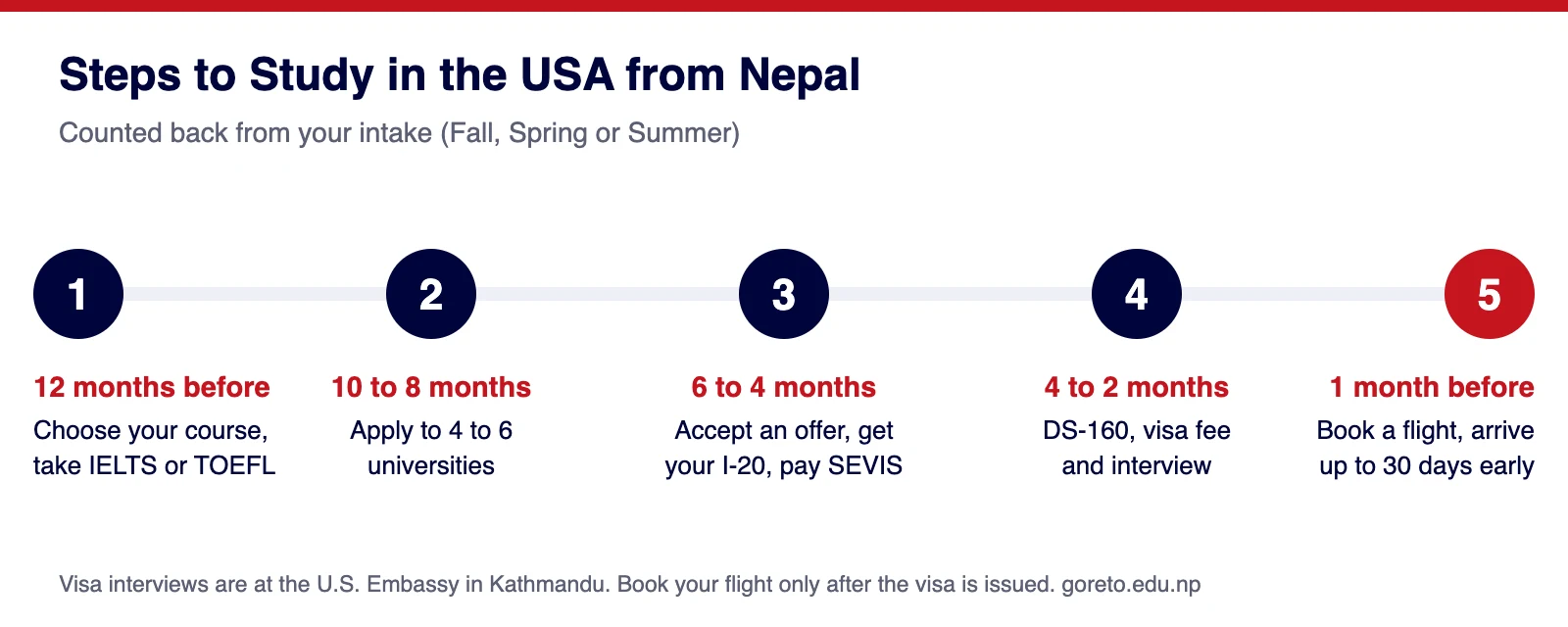
Once you have your I-20, you pay the $350 SEVIS fee, fill in the DS-160 form, pay the $185 visa fee and attend an interview at the U.S. Embassy in Kathmandu.
The U.S. student visa page says most degree students need the F-1 visa, and exchange students on a sponsored programme use the J-1 visa. Our guide to the F-1 student visa from Nepal covers each step, and our page on US student visa requirements lists every document.
First pay the SEVIS fee on the ICE I-901 page, which our guide on how to pay the SEVIS fee in Nepal shows step by step. Then you fill in the DS-160, pay the visa fee and book the interview at the embassy in Maharajgunj.
The interview is short, often just a few minutes, so prepare clear answers about your course, money and plans. Our US student visa interview tips list common questions. After the interview you can follow your case with our guide on how to check your US student visa status. Here is the usual order.
Your university sets the English score, and many ask for IELTS 6.0 for a bachelor’s and 6.5 for a master’s, or a similar TOEFL, PTE or Duolingo score.
The visa itself has no English test. Most US universities accept more than one test, and many accept the Duolingo English Test, which you can take at home in Nepal. The minimum is on each course page, and it can be higher for nursing, law or teaching. Our guide to English tests in Nepal compares IELTS, TOEFL, PTE and Duolingo.
Some universities waive the test if your bachelor’s was taught in English, but many do not accept this from Nepal. Your English also matters at the visa interview, because the officer talks to you directly in English, so practise speaking about your plan.
Nepali students can get university merit scholarships, assistantships for master’s and PhD study, and the Fulbright Master’s and Humphrey awards through USEF-Nepal.
USEF-Nepal, the Fulbright Commission in Nepal, runs the Fulbright Master’s programme and the Humphrey Fellowship for Nepali citizens. They are full awards with few places, so treat them as a bonus, not your only plan.
Most help comes from the universities themselves. Many give merit scholarships to strong international students with the offer. Master’s and PhD students can also apply for teaching or research assistant posts that cover part of the fee and pay a monthly stipend. Our page on scholarships in the USA for Nepali students lists the main ones.
More key numbers to plan with before you apply.
20 hours a week – on-campus work while classes run.
12 months – OPT work after each degree level.
24 months – extra OPT for STEM graduates.
4 years – the longest first admission on an F-1.
Start about 12 months before your intake: choose your course, take your English test, apply, get your I-20, then pay the SEVIS fee and attend the visa interview.
Fall, which starts in August or September, is the main intake, and Spring and Summer have fewer courses. Our guide to USA intakes shows the usual deadlines for each. Dates on offers and the I-20 are in the English calendar, so our Nepali date converter helps you match them to Bikram Sambat.
Yes, but only on campus in your first year: up to 20 hours a week while classes run and full time in the breaks.
Study in the States sets the 20-hour limit and says you need a Social Security number to be paid. Common jobs are in the library, dining hall, labs and student offices, and our guide to on-campus jobs in the USA lists more.
Off-campus work is not allowed in the first academic year, as USCIS explains for students. After that, you can work off campus only through CPT, which must be part of your course, or OPT. Our guide to CPT vs OPT for F-1 students explains the difference, and our list of part-time jobs in the USA shows typical pay. Treat your wages as help with food and rent, not as your plan for tuition.
Yes. After each degree you can work for 12 months on OPT, and graduates with a STEM degree can add 24 more months.
You apply for OPT near the end of your course, and the job must relate to what you studied. Many graduates use this time to find an employer who will sponsor an H-1B work visa, which is chosen by lottery. Our guide on how Nepali students can stay in the USA after study explains each route.
Study alone does not lead to a green card, and the F-1 visa expects you to have plans to return. Our guide on how to get PR in the USA after studying explains the longer path.
Yes. Your husband or wife and unmarried children under 21 can come on F-2 visas, but they cannot work in the USA.
Your university adds money for each family member to your I-20, so the amount you show goes up. Our guide to the F-2 visa for F-1 student dependants explains what they can and cannot do. Children can go to school, but a spouse who wants to study full time needs a student visa of their own.
Many Nepali students go alone first and bring family later, once they know their costs. Think about this before the interview, because bringing family changes the money you must show and the questions you may be asked.
Most refusals happen because the officer is not convinced you are a genuine student who will return, or that your money and study plan make sense.
US law presumes every visitor plans to stay unless they show otherwise, and many refusals are made under section 214(b) of that law. Our page on US student visa rejection reasons explains each reason and what to do next. Weak answers about your course, a sudden deposit with no clear source, or a plan that does not match your past study are the common problems.
You can apply again after a refusal, but only with a better case, not the same papers. No one can promise you a visa, so be careful of any agent who does. Your chances depend on your own marks, study plan, money and answers.
The USA is worth it if you choose an affordable university, have your first-year money ready and pick a course with work after study.
It suits students who want choice, flexible study and the chance of up to 3 years of work after a STEM degree. It suits students less if the family budget depends on part-time work, because the rules limit work in the first year. Our guide to life as a Nepali student in the USA covers the weather, classes and culture.
You can get advice wherever you live in Nepal, from Dhangadhi to Jhapa, at our branches in Kathmandu, Lalitpur (Kumaripati), Chitwan, Itahari and Pokhara, or online. Get in touch with a Goreto counselor to check your marks and budget, or read why students choose our consultancy for the USA in Nepal.
Most degree students need the F-1 student visa. Students on a sponsored exchange programme use the J-1, and students on a vocational course use the M-1. You apply after your university sends your I-20.
Many universities ask for a +2 GPA of about 2.5 to 3.0 for a bachelor’s, and many master’s courses prefer 3.0 or more. Each university sets its own entry, and community colleges often accept lower marks, so check the course page.
Yes, at many universities. Most accept TOEFL, PTE or the Duolingo English Test instead, and a few waive the test if your study was in English. Check each course page, because each university decides.
You pay the $350 SEVIS fee and the $185 visa application fee. Both are non-refundable, even if the visa is refused. Check the U.S. Embassy page before you pay, in case a new fee has been added.
F-1 interviews are held at the U.S. Embassy in Maharajgunj, Kathmandu. You book the date after paying the visa fee and completing the DS-160. Take your passport, I-20, SEVIS receipt and money papers.
Yes. Most Nepali students show a parent’s savings with a sponsor letter, a relationship certificate and papers that show the family’s income. The officer may ask how the money was earned, so keep the papers that show its source.
From 15 September 2026, you are admitted until the end date on your I-20, for up to 4 years. If your course takes longer, you apply to USCIS to extend your stay, and after the course you have 30 days to leave or start OPT.
Only in the breaks. While classes run you can work up to 20 hours a week on campus, and off-campus work needs CPT or OPT after your first year.
Yes, for students who choose an affordable university, have their first-year money ready and pick a course with work after study. STEM graduates get the longest work time, up to 3 years on OPT.
No. You can apply to universities yourself and book the visa online. Many families still use a counselor to choose universities, prepare the money papers and practise the interview, because one weak answer can cost an intake.
Goreto works with universities and colleges across the USA, including University of Akron, Concordia University Chicago, Avila University, Metropolitan College of New York, Florida Memorial University, Herzing University, Rensselaer Polytechnic Institute, Penn State Dickinson Law and LIM College. Their strong fields include engineering, business, computer science, nursing, education, aviation, fashion business and law. Programs change by university and intake, so a counselor checks which one fits your marks and budget. You can also read our best universities in the USA and top colleges in the USA pages.
Fall starts in August or September and suits most students, because it has the widest choice of programs and scholarships. Spring starts in January and works if you miss Fall. Summer starts in May, but only some universities offer it. Apply early so you have time for admission, scholarships and your visa. Our USA intakes guide explains each one.
Most students choose an on-campus residence hall, a shared apartment, private housing off campus or, at some places, a homestay. A residence hall is easy in the first year because it is on campus. Shared apartments usually cost less. Ask your university which housing it offers before you book anything.
Ready to start your USA plan? A Goreto counselor can check your marks, budget and documents and help you choose the right university and intake.
Reference links
Important guidance note
This page provides general guidance about studying abroad. Requirements, fees and policies can change. For advice about your situation, speak with a Goreto counselor before applying.
Book Your Free Consultation
From choosing the right country to finding scholarships and housing, our counselors will guide you at every step.
Choose the right country based on your goals
Find courses that match your career plan
Get guidance on colleges and universities
Plan your finances, scholarships & part-time jobs
Plan your abroad stay & post-study plan
Schedule a free consultation with our expert counselors to discuss your study
Schedule a free consultation with our expert counselors to discuss your study