

Dhiraj Kandel
Managing DirectorSchedule a free consultation with our expert counselors to discuss your study
The essentials at a glance
What Is a Relationship Certificate with a Sponsor? A Relationship Certificate with Sponsor, commonly known as “Nata Pramanit” in Nepal, is an official government-issued document that legally confirms the family relationship between a student and the person sponsoring their study-abroad expenses.
Main points from this page
If your father, mother, brother, sister, uncle, aunt, or spouse is paying for your study abroad expenses, you need a Relationship Certificate with Sponsor, which is commonly known in Nepal as “Nata Pramanit”.
It is an official document issued by your local ward office or municipality that legally proves your relationship with the person sponsoring your tuition fees, living costs, bank balance, or visa expenses.
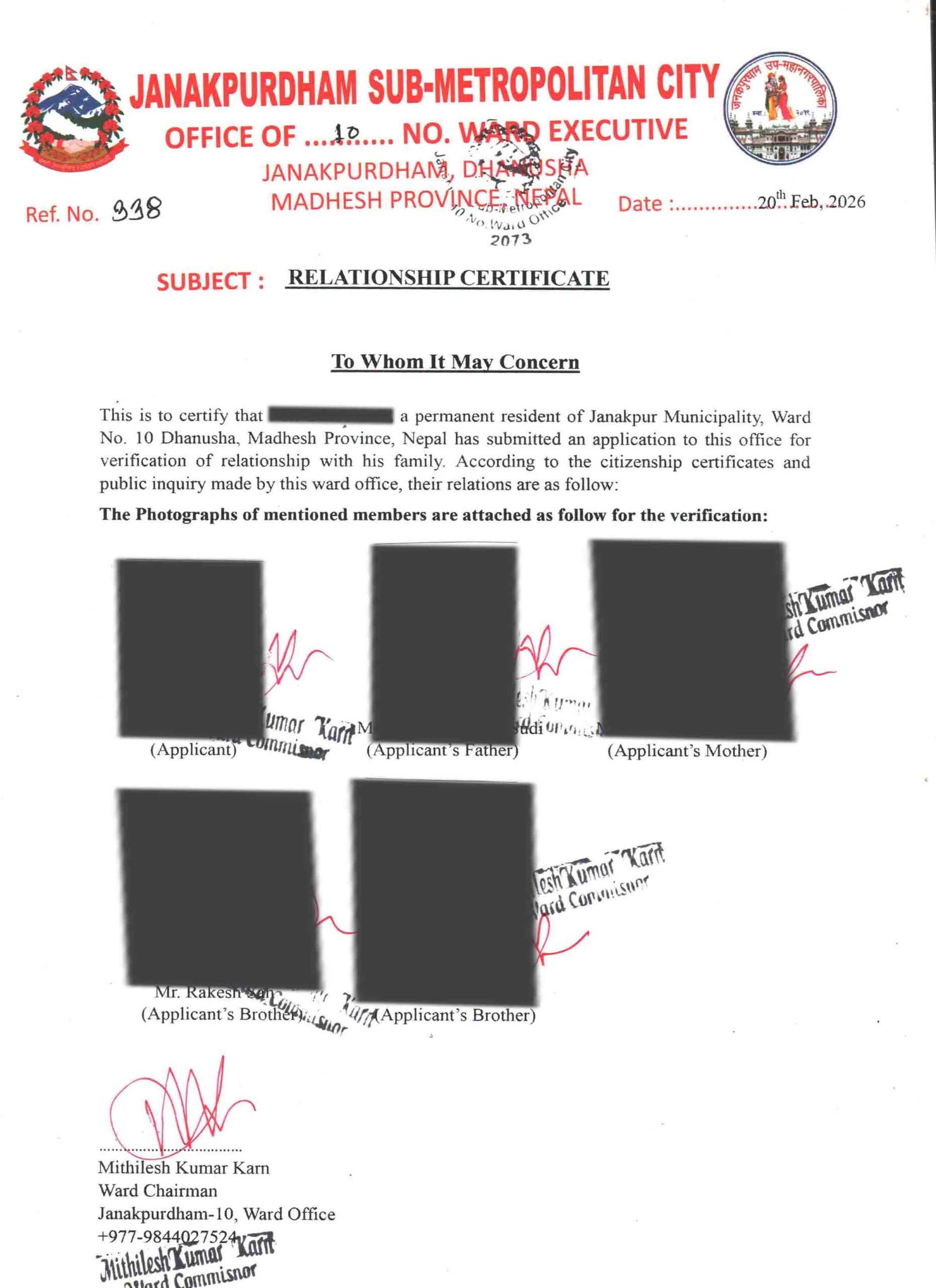
[Sample]
A Relationship Certificate is written in the following way:
“This is to certify that Mr. [Student Name] is the son of Mr. [Father’s Name], Mrs. [Mother’s Name], and husband of Mrs. [Spouse’s Name], a permanent resident of (FULL ADDRESS). This certificate is issued in accordance with Chapter (3) section (12) sub-section (2) clause (E) 1 of the Local Government Operation Act 2074 B.S. (2017), for foreign purposes. The photographs below depict their identities.”
Important Note: The student’s name, sponsor’s name, and all personal details on the certificate must exactly match those on the passport and citizenship to avoid issues during university admission or visa processing.
Example of full address: Budhanilkantha Municipality, Ward No. 11(Om Shanti Toll), Kathmandu, Nepal
A Relationship Certificate with Sponsor, commonly known as “Nata Pramanit” in Nepal, is an official government-issued document that legally confirms the family relationship between a student and the person sponsoring their study-abroad expenses.
This document is important when the university, embassy, or visa officer needs proof that a specific person is financially supporting the student’s education. It helps verify whether the sponsor is a genuine family member and whether the financial support is legitimate.
A Relationship Certificate with the sponsor is required when someone other than the student is paying for study abroad expenses. Many students from Nepal use their parents, siblings, spouses, uncles, aunts, or other close relatives as financial sponsors. In such cases, the university, embassy, or visa officer needs clear proof of the sponsor’s relationship to the student.
This document helps the visa officer understand:
Without clear proof of relationship, even strong financial documents such as bank balance certificates, income sources, salary certificates, or education loans may raise questions during the admission or visa process.
| Country | Where It Is Commonly Used | Why Relationship Proof Matters |
| Australia | GS (Genuine Student) files, sponsor letters, bank balance source, income explanation, education loan top-up, uncle or sibling sponsorship | Helps prove why a parent, sibling, or relative is financially supporting the student and strengthens GS’s credibility |
| UK | Tuition sponsor proof, maintenance funds, dependent sponsor relationship, and family-funded university applications | Confirms the legal relationship between the student and the person covering tuition or living costs |
| Canada | GIC support top-up, sponsor savings, tuition transfer proof, and Canada study permit documentation | Supports the source of funds and validates family sponsorship used for tuition and living expenses |
| USA | I-20 financial documents, F-1 visa files, parents’ bank statements, sponsor affidavit, DS-160 consistency | Connects the sponsor’s bank balance and affidavit with the actual family relationship for visa credibility |
A sponsor can be a parent, spouse, sibling, uncle, aunt, or legal guardian who agrees to financially support a student’s tuition fees, living expenses, and other study abroad costs.
In Nepal, the most common acceptable sponsors are:
| Sponsor Type | Common Use |
| Father | Most common sponsor |
| Mother | Common if the mother has a salary/business income |
| Husband / Wife | Spouse sponsorship |
| Siblings | Accepted for student visa sponsorship if the brother or sister has strong financial capacity, clear income proof, proper bank statements, and a valid relationship certificate. |
| Uncle / Aunt | Common for abroad-employed relatives |
| Legal Guardian | When parents are unavailable |
| Joint Sponsorship | Used for stronger funds |
To get a Relationship Certificate in Nepal, you need the student’s and sponsor’s citizenship copies, proof of family relationship, passport-size photos, and ward documents such as the application form, tax receipt, or migration paper if the address has changed.
Keep these documents of the student ready:
You will also need documents from the person sponsoring your education:
These documents help the ward office legally verify the family relationship:
Some ward offices may additionally ask for local supporting papers:
If the district listed on your citizenship and your current ward address are different, the ward office may request additional verification documents. These may include:
To obtain a Relationship Certificate in Nepal, you must visit your local ward office with copies of everyone’s citizenship documents, proof of family relationship documents, and everyone’s passport-size photos. Then fill out the required application form. After document verification, the ward office will issue the certificate, usually on the same day or within a few working days.
Go to the ward office where your family is permanently registered. This is usually based on:
Request the Relationship Certificate application form, commonly known in Nepal as the Nata Pramanit form, from your local ward office or municipality.
Enter the details that match the official documents, such as passports, citizenship documents, academic documents, bank letters, and a sponsor affidavit. Enter:
Submit photocopies of:
The ward office may verify using:
In some cases, they may ask for a local witness.
The fee for a Relationship Certificate in Nepal is usually minimal and depends on your municipality’s rules. In most wards, it is only a small administrative charge of a few hundred rupees, and you should always ask for the official receipt after payment.
After verification, the ward office issues the Relationship Certificate with the official seal, authorized signature, ward letterhead, issue date, and ward number. For study abroad and visa use, always scan the certificate clearly in color so all stamps and details remain visible.
If all your documents are ready, most ward offices in Nepal issue the Relationship Certificate on the same day. In some municipalities, it may even be issued within 1 to 2 working days. The document can be received on the same day when:
During university admission and visa application seasons, ward offices are more crowded, so it is better to apply early to avoid delays.
Need help checking your sponsor documents for study abroad? Goreto can help you review your Relationship Certificate, bank balance source, sponsorship letters, and other Nepal-specific visa documents before submission.
A student can be sponsored by a father, mother, spouse, brother, sister, uncle, aunt, or a legal guardian. They can be individual sponsors or joint sponsors (such as your father + mother) as long as the financial source is genuine and properly documented.
Yes, most sponsor-based student visa cases from Nepal require a Relationship Certificate. It is especially important when someone other than the student is paying for tuition fees, living expenses, bank balance, or visa costs, as it helps the university and visa officer verify the legal relationship between the student and the sponsor.
Yes, many ward offices issue it on the same day if your citizenship address matches the current ward, your family details are already in the records, and no migration verification is needed. However, it may take 1–2 working days if there are confusions or if further documents are required.
Yes, your brother or sister can sponsor you if they can show a genuine source of funds, and you provide a valid Relationship Certificate to prove the family relationship.
Yes, the same certificate can be used for student visa applications to Australia, the UK, Canada, and the USA, as long as the student and sponsor details are correct and match the passport and Citizen
Important guidance note
This page provides general guidance about studying abroad. Requirements, fees and policies can change. For advice about your situation, speak with a Goreto counsellor before applying.
Book Your Free Consultation
From choosing the right country to finding scholarships and housing, our counselors will guide you at every step.
Choose the right country based on your goals
Find courses that match your career plan
Get guidance on colleges and universities
Plan your finances, scholarships & part-time jobs
Plan your abroad stay & post-study plan

Schedule a free consultation with our expert counselors to discuss your study

Schedule a free consultation with our expert counselors to discuss your study