

Dhiraj Kandel
Managing DirectorSchedule a free consultation with our expert counselors to discuss your study
The essentials at a glance
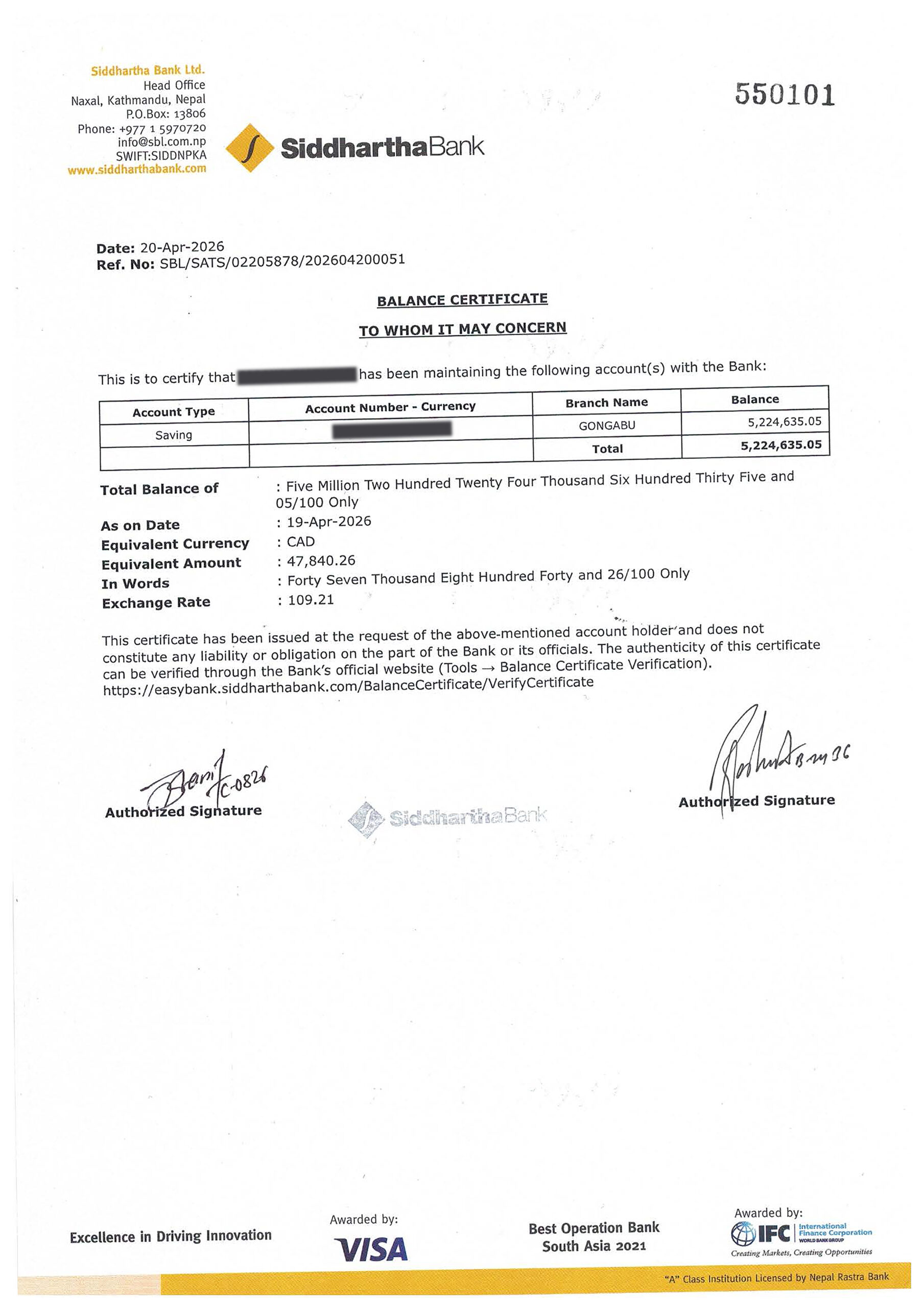
What is a Bank Balance Certificate for a Student Visa? A Bank Balance Certificate for a Student Visa is an official letter issued by a bank confirming the exact available balance in a savings account, fixed deposit account, or both as of the date of issuance.
Main points from this page
If your father, mother, spouse, or another sponsor is using their bank account to support your study abroad expenses, you will need a Bank Balance Certificate as part of your student visa financial documents.
Issued by a Nepali bank on official letterhead, this certificate confirms the exact available balance in the bank account. It helps universities and visa officers verify whether you have sufficient funds to cover tuition fees, annual living costs, and other study-related expenses in countries such as Australia, the UK, Canada, and the USA.
A Bank Balance Certificate for a Student Visa is an official letter issued by a bank confirming the exact available balance in a savings account, fixed deposit account, or both as of the date of issuance. It is used in visa applications to demonstrate that the student or sponsor has sufficient liquid funds to cover tuition fees, living expenses, airfare, visa costs, and basic financial support for the duration of the study period.
In simple terms, the bank certifies the available balance, the student uses it as proof of funds, and the visa officer verifies that the funds are sufficient. This document clearly connects the source of funds to the student’s study plan, making the financial aspect of the visa application more credible and easier to assess.
You need a Bank Balance Certificate for a Student Visa to prove to universities and visa officers that you or your sponsor has enough funds to cover tuition fees, living expenses, and other study abroad costs.
The certificate helps answer critical visa questions:
For Nepalese students, a Bank Balance Certificate becomes even more important when parents are sponsoring tuition, siblings are supporting study-abroad expenses, education loan funds are used partially, multiple sponsors combine their balances, or recent deposits require a proper source explanation to satisfy university and visa financial checks.
| Country | Common Use | Why It Matters |
| Australia | GS file, tuition + living proof | Supports Genuine Student financial credibility by showing that the student or sponsor has enough funds for tuition fees, yearly living costs, and other study expenses. |
| UK | CAS funds, tuition + maintenance | Confirms the required 28-day accessible funds needed for tuition fees and maintenance as part of the student visa financial checks. |
| Canada | Canada study permit funds, tuition + GIC | Shows remaining sponsor strength and proves that funds beyond tuition payment and GIC are available for additional living or emergency costs. |
| USA | I-20, F-1 visa interview | Supports consistency across the I-20, DS-160, affidavit of support, and financial questions during the visa interview. |
Bank Balance Certificate for Student Visa mentions things like this:
“[Bank Letterhead / Logo]
Date: 03 April 2026
TO WHOM IT MAY CONCERN
This is to certify that Mr. Ram Thapa, holder of Savings Account No. 0123456789012345 maintained with our bank, has an available balance of NPR 3,850,000 (Nepalese Rupees Thirty-Eight Lakh Fifty Thousand Only) as of the date of issuance of this certificate.
The above balance is held in the account in good standing and is available for the account holder’s personal and educational purposes, including overseas study expenses such as tuition fees, living costs, travel expenses, and other visa-related financial requirements.
This certificate has been issued upon the account holder’s request for a student visa and university financial verification purposes.
Sincerely,
[Authorized Bank Officer Signature]
Name: Sita Sharma
Designation: Branch Manager
Bank Seal / Official Stamp
Branch: Nabil Bank Limited, Putalisadak Branch, Kathmandu
Contact: 01-4XXXXXX”
“[Bank Letterhead / Logo]
Date: 03 April 2026
TO WHOM IT MAY CONCERN
This is to certify that Mrs. Janaki Thapa, holder of Savings Account No. 0123456789012345 maintained with our bank, has an available balance of NPR 5,200,000 (Nepalese Rupees Fifty-Two Lakh Only) as of the date of issuance.
The account holder is the mother and financial sponsor of Mr. Ram Thapa, who is applying for higher studies abroad. The above balance is available to support tuition fees, living expenses, travel, and other study-related costs.
This certificate is issued at the account holder’s request for student visa financial documentation purposes.
Sincerely,
[Authorized Signature]
Branch Manager
[Official Bank Stamp]”
The bank balance can be shown by the student or an eligible sponsor, such as the father, mother, husband, wife, brother, sister, uncle, aunt, legal guardian, or a combination of family sponsors.
For Nepalese students, it is quite common to use joint sponsorship from their parents when a single account does not have sufficient funds to cover tuition and living costs.
In these cases, the Bank Balance Certificate must clearly align with the relationship certificate, the sponsor letter, income-source documents, tax records, proof of remittance, business registration papers, and salary slips. This helps ensure the financial story remains consistent, genuine, and credible during university review and student visa assessment.
To get a Bank Balance Certificate in Nepal, visit your bank branch with the account holder’s citizenship document, account details, and a request letter signed by the account owner. The bank will issue the certificate on official letterhead after verifying the available balance.
Visit the branch where the account is maintained. Common banks include:
Ask for “Bank Balance Certificate for Student Visa Purpose.” Mention the destination country, as some banks customize the wording.
Usually required:
Most Nepalese banks charge a small administrative fee for issuing a Bank Balance Certificate. The typical charge is usually around NPR 300 to NPR 1,000, depending on the bank and branch. In most cases, this fee is deducted directly from the account holder’s bank account rather than paid separately in cash.
Once the bank verifies the account details and available balance, it will prepare the Bank Balance Certificate on official bank letterhead. The account holder may need to wait for the certificate to be printed, signed by an authorized bank officer, and stamped by the branch. In some banks, it may be issued on the same day, while others may ask you to collect it later.
Before leaving the bank, check that the certificate includes:
Always scan the final certificate clearly in color for visa submission, and make sure the name, balance amount, date, and sponsor details match your other financial documents.
For a student visa, the required bank statement is usually a full savings account statement (not screenshots or mini statements) covering recent transaction history, and the exact duration depends on the country.
The exact bank balance required for a student visa depends on the country, tuition fees, one-year living costs, visa rules, scholarship amount, education loan coverage, and the overall sponsor profile. The final amount should always be enough to clearly show that the student can manage study and living expenses without financial risk.
In practical Nepal visa files, the common structure is: Australia: tuition plus 1 year’s living costs; UK: tuition plus 9 months’ maintenance; Canada: tuition plus GIC and extra reserve funds; and USA: the full yearly cost as stated on the I-20.
For example, Canada’s IRCC requires a single student applying on or after September 1, 2026, to show at least CAD 23,448 for living expenses for the first year, excluding tuition fees and transportation costs. This means the actual required amount is usually first-year tuition, CAD 23,448 in living expenses, and travel/transportation costs.
Many Nepalese students lose credibility not because the balance is low, but because the source of funds, the sponsorship relationship, the certificate validity, or the country-specific amount does not align properly with the rest of the visa documents.
One of the most common mistakes is showing a fresh, large deposit just before certificate issuance without explaining where the money came from. For example, if a sponsor deposits NPR 40 lakh one day before the bank issues the certificate, visa officers may question whether the funds are genuinely available for study purposes.
Large deposits must always be supported by proper proof, such as a land sale deed, fixed deposit maturity receipt, business withdrawal record, proof of remittance, or a loan disbursement letter.
The sponsor’s name on the Bank Balance Certificate must exactly match the name on all other legal and financial documents. This includes the passport, citizenship, relationship certificate, sponsor affidavit, and bank statements. Even small spelling differences, missing middle names, or reversed surnames can create unnecessary doubts during document verification.
A common planning mistake is presenting a balance that does not align with the destination country’s actual financial requirements. Australia usually requires tuition plus one year of living costs; the UK requires tuition plus maintenance; Canada requires tuition plus GIC and reserve funds; and the USA follows the I-20 yearly cost. Using a generic amount without country-based calculation can weaken the visa file.
Many students use a Bank Balance Certificate that is too old at the time of application. Since embassies and universities prefer recent financial proof, a certificate older than 7 to 30 days may undermine trust, especially if the most recent bank transactions are not reflected in the document.
A strong bank balance alone is not enough if the sponsor’s connection to the student is unclear. The certificate must always be supported by a relationship certificate, a sponsor letter, proof of income sources, tax records, salary slips, or evidence of remittances so that the visa officer can clearly understand who owns the funds and why they are being used for the student’s education.
If you are applying to Australia, the UK, Canada, or the USA from Nepal, Goreto can review your complete set of financial documents before submission to ensure your visa file is accurate, credible, and country-ready.
This includes a full check of your bank balance certificate, source of funds, sponsor affidavit, relationship certificate, salary and tax proof, business income papers, education loan letters, and remittance verification.
For an Australian student visa, the required bank balance normally includes one year’s tuition fees, one year of living expenses, travel costs, OSHC, and any dependent expenses. As per Australia’s Department of Home Affairs financial capacity requirement, the minimum 12-month living cost amount for a student is AUD 29,710.
Yes, your father, mother, uncle, aunt, sibling, spouse, or legal guardian can show the bank balance, but the file must include a relationship certificate, a sponsor letter, and proof of a valid income source.
Most universities and embassies prefer a recent Bank Balance Certificate issued within 7 to 30 days, as older certificates may not reflect the latest available funds.
Yes, in most student visa applications, the Bank Balance Certificate should be supported by recent bank statements, usually covering 3–6 months or the country-specific required period, to demonstrate transaction history and the consistency of the source.
Yes, Nepalese students can use combined sponsorship from parents or other close family members, but each sponsor’s balance must be supported by proof of relationship, income documents, tax records, and evidence of the source of funds.
Important guidance note
This page provides general guidance about studying abroad. Requirements, fees and policies can change. For advice about your situation, speak with a Goreto counsellor before applying.
Book Your Free Consultation
From choosing the right country to finding scholarships and housing, our counselors will guide you at every step.
Choose the right country based on your goals
Find courses that match your career plan
Get guidance on colleges and universities
Plan your finances, scholarships & part-time jobs
Plan your abroad stay & post-study plan

Schedule a free consultation with our expert counselors to discuss your study

Schedule a free consultation with our expert counselors to discuss your study