


Dhiraj Kandel
Managing DirectorSchedule a free consultation with our expert counselors to discuss your study
The essentials at a glance
To get a PR in the USA after studying, most international students follow a long pathway: study on an F-1 visa, work after graduation through OPT or STEM OPT, move to an H-1B or other work visa, and then apply for a Green Card through employer sponsorship or another eligible route. The process depends on your course, job, employer, immigration category, and U.S. rules.
Main points from this page
To get a PR in the USA after studying, most international students follow a long pathway: study on an F-1 visa, work after graduation through OPT or STEM OPT, move to an H-1B or other work visa, and then apply for a Green Card through employer sponsorship or another eligible route. The process depends on your course, job, employer, immigration category, and U.S. rules.
Most students move from an F-1 visa to OPT, then to an H-1B visa or another work status, and later to a Green Card route if eligible. For Nepalese students planning to study in the USA, this means one thing: your course, university, career plan, and visa compliance all matter. You should treat USA permanent residency after your studies as a long-term possibility, not a guaranteed outcome.
International students can move from an F-1 visa to a Green Card by studying legally in the USA, using OPT or STEM OPT for work experience, finding an employer willing to sponsor a work visa, and later qualifying for an eligible Green Card pathway.
| Stage | Visa / Status | What It Means | Key Point |
| 1 | F-1 Student Visa | Study legally in the USA | Does not directly give PR |
| 2 | OPT / STEM OPT | Temporary work after study | Helps build U.S. work experience |
| 3 | H-1B or Other Work Visa | Employer-sponsored work visa | Often used before Green Card |
| 4 | Green Card Sponsorship | Employer or eligible route | Can lead to permanent residency |
| 5 | Permanent Resident Status | Green Card holder | Allows long-term stay and work |
Most Nepalese students planning to study in the USA apply for an F-1 visa. This visa is mainly for academic study at a recognised U.S. school, college, or university.
To stay in good standing, students must maintain a valid student status, comply with academic requirements, and avoid unauthorised work. Maintaining F-1 status matters because future benefits, such as OPT, can depend on whether the student has followed the rules.
At this stage, students should focus on:
OPT, or Optional Practical Training, is temporary work authorisation for F-1 students. USCIS describes OPT as temporary employment that must be directly related to the student’s major area of study.
For many international students, OPT is the first practical step toward working in the USA after graduation. It allows students to gain U.S. work experience, understand the job market, and prove their skills to employers.
However, OPT is still temporary. It is not PR. It does not automatically lead to an H-1B visa or a Green Card. It simply gives eligible students a legal period to work in a field related to their studies.
Some students may qualify for STEM OPT, an extension of post-completion OPT for certain F-1 students with eligible degrees in science, technology, engineering, and mathematics. Certain F-1 students with STEM degrees may apply for a 24-month extension of post-completion OPT.
This is why course selection matters. A STEM-designated course can provide a longer work authorisation period compared to regular OPT. For Nepalese students who want to study in the USA and settle long-term, this can make a major difference. But not every course is STEM eligible. Students should check the university program details carefully before applying.
After OPT or STEM OPT, many international students try to move to the H-1B visa. The H-1B is commonly used by U.S. employers to hire foreign professionals in speciality occupations. The H-1B visa is for people working in speciality occupations that usually require highly specialised knowledge and at least a bachelor’s degree or equivalent qualification.
This is where employer sponsorship becomes very important. A student usually cannot simply decide to get an H-1B visa on their own. A U.S. employer must be willing to sponsor the visa.
Important things to understand:
Students should always verify H-1B rules through official USCIS sources before making decisions.
For many international students, the most realistic route to USA permanent residency after study is through employer-sponsored Green Card categories such as EB-2 or EB-3.
The EB-2 category may apply to people with an advanced degree or exceptional ability, while the EB-3 category may apply to skilled workers, professionals, or other workers. These categories are not automatically available to every graduate; eligibility depends on the job, qualifications, employer, and immigration rules.
In many employer-sponsored cases, the employer may need to complete a PERM labour certification process. A permanent labour certification allows an employer to hire a foreign worker permanently in the United States, and in most cases, the employer must obtain certification before submitting an immigration petition to USCIS.
This is why employer support is so important. A good degree helps, but the Green Card process often depends on whether an employer is ready to sponsor the student for a permanent role.
After a Green Card petition reaches the right stage, the applicant may complete the final process through Adjustment of Status or Consular Processing, depending on their situation.
Adjustment of Status is the process used to apply for lawful permanent resident status from inside the United States. Consular Processing is generally used when a person applies for an immigrant visa through a U.S. embassy or consulate outside the United States, or when they are not eligible to adjust status inside the U.S.
Students should not treat this as a simple form-filling step. Immigration history, visa status, job sponsorship, priority dates, country-specific rules, and legal eligibility can all matter. A qualified immigration attorney should be consulted for personal legal advice.
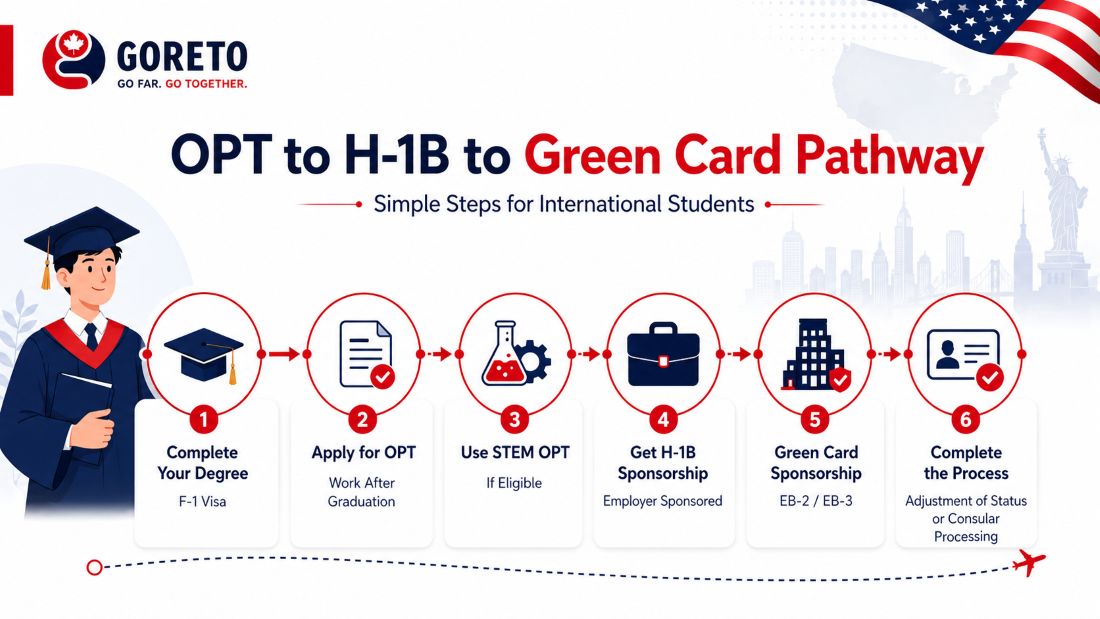
The OPT-to-H-1B-to-Green Card pathway is one of the most common routes international students consider after studying in the USA, but it is not automatic or guaranteed.
Here is how the process usually works:
First, you study in the USA under a valid F-1 student status. During this time, you should maintain your student status, follow university rules, and avoid unauthorised work.
After completing your degree, you may apply for OPT, which allows eligible F-1 students to work temporarily in a job related to their field of study.
If your degree is in an eligible STEM field, you may qualify for a STEM OPT extension. This can give you more time to gain U.S. work experience and find an employer willing to sponsor you.
The next common step is finding a U.S. employer who is willing to sponsor your H-1B visa. The H-1B is usually for speciality occupation jobs that require specific skills, knowledge, and at least a bachelor’s degree or equivalent.
After working on H-1B, your employer may decide to sponsor you for a Green Card through an eligible employment-based category, such as EB-2 or EB-3.
Depending on your situation, the final stage may involve employer filing, labour certification, immigrant petition, priority dates, and either Adjustment of Status inside the USA or Consular Processing outside the USA.
Not every international student follows the same path from an F-1 visa to OPT, H-1B, and an employer-sponsored Green Card. Some students may qualify for other Green Card routes depending on their family situation, country eligibility, qualifications, achievements, or long-term career profile.
However, these routes are not automatic or guaranteed simply because a student has studied in the USA. Students should always check official U.S. government sources and speak with a qualified immigration attorney before making any immigration decision.
Some students may become eligible for a family-based Green Card through a qualifying relationship with a U.S. citizen or lawful permanent resident. This may depend on the type of family relationship, the sponsor’s status, visa availability, and other immigration requirements.
This route is based on personal family circumstances, not on studying in the USA.
The Diversity Visa Lottery is a separate immigrant visa program managed by the U.S. Department of State. Eligible applicants must submit their entries electronically during the official registration period and follow the program rules carefully.
This route is not directly connected to a U.S. degree or student visa. Also, being selected in the Diversity Visa Lottery does not automatically mean final Green Card approval. Applicants must still meet all eligibility, documentation, and interview requirements.
Some highly qualified international students or graduates may later explore categories such as EB-1 or EB-2 National Interest Waiver. These routes are usually for people with exceptional ability, strong research backgrounds, advanced qualifications, major professional achievements, or work that may benefit the United States.
These options are uncommon among most fresh graduates. They usually require a strong profile, detailed evidence, and professional legal review.
International students may use Green Card routes such as employer sponsorship, family sponsorship, the Diversity Visa Lottery, the EB-1, the EB-2 National Interest Waiver, or other eligible categories, depending on their personal situation and qualifications.
| Green Card Route | Who It May Fit | Important Note |
| Employer-sponsored EB-2 | Advanced degree professionals or eligible skilled workers | Often needs employer sponsorship and may require PERM |
| Employer-sponsored EB-3 | Skilled workers, professionals, or other eligible workers | Often used for employment-based sponsorship |
| Family-based Green Card | Students with eligible U.S. citizen or permanent resident family relationships | Depends on family category and eligibility |
| Diversity Visa Lottery | Students from eligible countries | Eligibility can change and must be verified officially |
| Exceptional categories | People with extraordinary ability or special eligibility | Requires strong evidence and legal review |
Some people may apply for a Green Card while in F-1 status if they qualify under a valid category. However, F-1 is a non-immigrant student status. Green Card intent can create complex immigration questions. You should not treat a direct Green Card filing from an F-1 as a simple student pathway. Speak with a qualified immigration attorney before taking action.
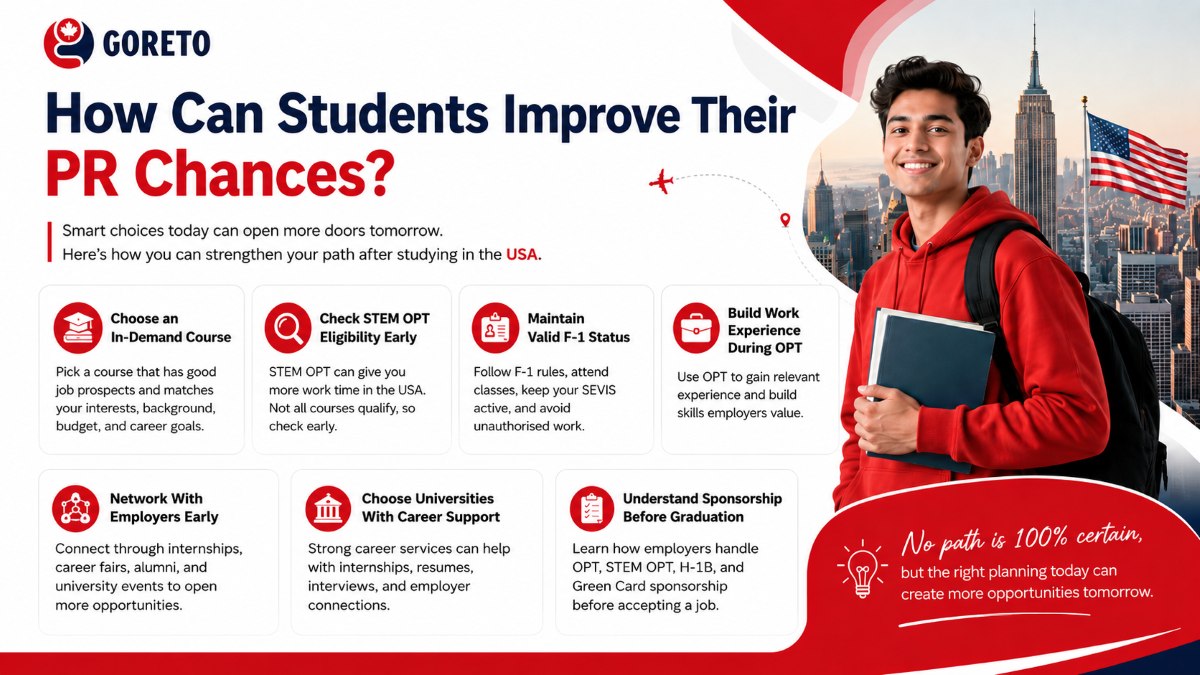
Students can improve their long-term prospects by choosing the right academic path, maintaining valid status, and developing employable skills. These actions do not guarantee PR, but they support stronger future options.
Many international students expect a straightforward, simple process for obtaining PR in the USA after studying. In reality, studying in the USA can help you build a strong academic and career profile, but it does not automatically give you permanent residency. Understanding these common misconceptions can help students plan more realistically and avoid poor decisions.
No, you do not get PR automatically after studying in the USA. A U.S. degree can improve your career opportunities, but permanent residency requires a separate eligible Green Card pathway, such as employer sponsorship, family sponsorship, or another qualifying immigration category.
Yes, you may be able to stay in the USA after graduation if you have valid authorisation. Many students use OPT or STEM OPT after completing their studies, while others may later move to a work visa or another lawful status. You must always follow USCIS, SEVIS, and visa status rules.
No, H-1B is not guaranteed after OPT. To move from OPT to H-1B, you usually need a U.S. employer willing to sponsor you, and the job must meet the required eligibility conditions. Some H-1B applications may also depend on selection rules and current immigration procedures.
No, not all courses qualify for STEM OPT. Only eligible STEM-designated programs can allow students to apply for the STEM OPT extension. This is why students who want longer work authorisation after graduation should check whether their chosen course is STEM eligible before applying.
Some students may be able to apply for a Green Card route while on F-1 status, but this can be legally complex. F-1 is a non-immigrant student status, while a Green Card is for permanent residency. Students should speak with a qualified immigration attorney before making any Green Card decision from F-1 status.
Getting PR in the USA after studying is not automatic, but the right planning can help you make better decisions from the beginning. Your course choice, university, visa status, career preparation, OPT eligibility, and employer opportunities can all affect your future options.
If you are planning to study in the USA from Nepal, speak with an experienced study abroad advisor before choosing your course or university. Proper guidance can help you understand your study options, prepare your documents, and build a realistic pathway for your academic and career goals in the USA.
Yes, international students can get PR in the USA after studying, but it is not automatic. Most students first study on an F-1 visa, then use OPT or STEM OPT, move to an H-1B or another work visa, and later apply for a Green Card through employer sponsorship or another eligible route.
The most common pathway is F-1 student visa → OPT or STEM OPT → H-1B work visa → employer-sponsored Green Card → permanent resident status. However, each step has eligibility rules, employer requirements, and immigration conditions.
OPT does not directly lead to a Green Card. OPT is a temporary work authorisation for eligible F-1 students. It can help students gain U.S. work experience and find an employer who may later sponsor an H-1B visa or Green Card.
H-1B is not always required, but it is one of the most common routes international students use before applying for an employer-sponsored Green Card. Some students may qualify through other routes, such as family sponsorship, EB-1, EB-2 National Interest Waiver, or Diversity Visa Lottery, depending on their situation.
No, PR is not guaranteed after studying in the USA. A U.S. degree can improve your career opportunities, but permanent residency depends on your visa status, job offer, employer sponsorship, immigration category, eligibility, and current U.S. immigration rules.
Important guidance note
This page provides general guidance about studying abroad. Requirements, fees and policies can change. For advice about your situation, speak with a Goreto counsellor before applying.

Book Your Free Consultation
From choosing the right country to finding scholarships and housing, our counselors will guide you at every step.
Choose the right country based on your goals
Find courses that match your career plan
Get guidance on colleges and universities
Plan your finances, scholarships & part-time jobs
Plan your abroad stay & post-study plan

Schedule a free consultation with our expert counselors to discuss your study

Schedule a free consultation with our expert counselors to discuss your study