

Dhiraj Kandel
Managing DirectorSchedule a free consultation with our expert counselors to discuss your study
The essentials at a glance
What is a Recommendation Letter? A letter of recommendation is a formal letter written by a teacher, professor, employer, supervisor, or mentor who knows you well. It should explain who you are, how the recommender knows you, your strengths, and why you are a strong candidate for a course, college, university, or scholarship. For study abroad, it matters because it adds evidence beyond grades and test scores.
Main points from this page
A recommendation letter, also called a Letter of Recommendation (LOR), is a formal letter written by your professor, teacher, supervisor, or employer to support your admission by explaining your academic strengths, character, skills, and suitability for the course you want to study.
For students applying from Nepal, recommendation letters are commonly required for Bachelor’s, Master’s, MBA, scholarship, and PhD applications to countries such as the USA, Canada, the UK, and Australia. Universities use this letter to understand your performance beyond grades and test scores, which is why a strong and genuine recommendation can significantly improve your admission chances.
A letter of recommendation is a formal letter written by a teacher, professor, employer, supervisor, or mentor who knows you well. It should explain who you are, how the recommender knows you, your strengths, and why you are a strong candidate for a course, college, university, or scholarship.
For study abroad, it matters because it adds evidence beyond grades and test scores. Admissions teams want to know how you perform in real settings.
A useful letter answers these questions fast:
Common types of recommendation letters include academic letters from teachers or professors, professional letters from employers or managers, and scholarship letters supporting funding applications. For study abroad, Nepali students most commonly need academic LORs for Bachelor’s, Master’s, MBA, and PhD admissions, while working professionals may also need employer-based recommendation letters for graduate programs.
| Type | Who writes it | Main purpose | Best use case |
| Academic recommendation | Teacher, professor, supervisor | Shows academic ability and learning potential | College, graduate school, scholarship |
| Professional recommendation | Manager, employer, team lead | Shows work performance and reliability | Jobs, internships, MBA, and some master’s programs |
| Character recommendation | Mentor, community leader, coach | Shows integrity and personal qualities | Limited use; only when requested |
| Research recommendation | Research guide, professor | Shows analytical and project skills | Graduate school, research programs |
A strong letter of recommendation should clearly explain who is writing the letter, their relationship with the student or employee, and how long they have known them. It should highlight the person’s academic performance, professional skills, achievements, character, leadership, communication, and suitability for the course, scholarship, or job opportunity.
To make the recommendation letter more effective, it should also include specific examples or real situations that demonstrate the candidate’s strengths rather than relying solely on generic praise.
The closing part should contain a clear endorsement statement, the recommender’s name, designation, institution or company, official email, and contact details, which helps universities and organizations verify the authenticity of the letter.
Key Elements a Recommendation Letter Must Include
You should ask someone who knows your academic or professional strengths well and can genuinely speak about your abilities, achievements, and character. For study abroad applications, the best choice is usually a teacher, professor, thesis supervisor, project mentor, employer, or direct manager who has worked closely with you and can provide concrete examples of your performance.
For students in Nepal, professors at universities such as Tribhuvan University and Kathmandu University, or faculty at your college, are often the best recommenders for Bachelor’s, Master’s, and PhD applications. If you are applying for an MBA or have a study gap with work experience, an employer or reporting manager can write a stronger professional recommendation letter.
Best People to Ask for a Recommendation Letter
To get a strong recommendation letter, choose a professor, supervisor, or employer who knows your work well, ask them politely at least a few weeks early, and share your course details, deadline, CV, and key achievements to help them write a personalized letter.
Select someone who knows your academic performance, project work, research ability, or professional skills closely. The best options are usually a professor, thesis supervisor, project mentor, employer, reporting manager, or internship supervisor.
For study abroad applications, professors and academic supervisors are usually the strongest choice because they can better explain your academic readiness and future potential.
Always request the letter of recommendation at least 2–3 weeks before the application deadline. Asking early gives the recommender enough time to write a thoughtful, personalized, and well-structured letter instead of a rushed, generic one.
Tell them exactly:
This helps them align the letter with your actual purpose.
To make the writing process easier, send:
The more context they have, the better and more personalized the recommendation letter becomes.
Make sure they clearly understand how the recommendation needs to be submitted, whether it should be:
Clear instructions reduce mistakes and delays.
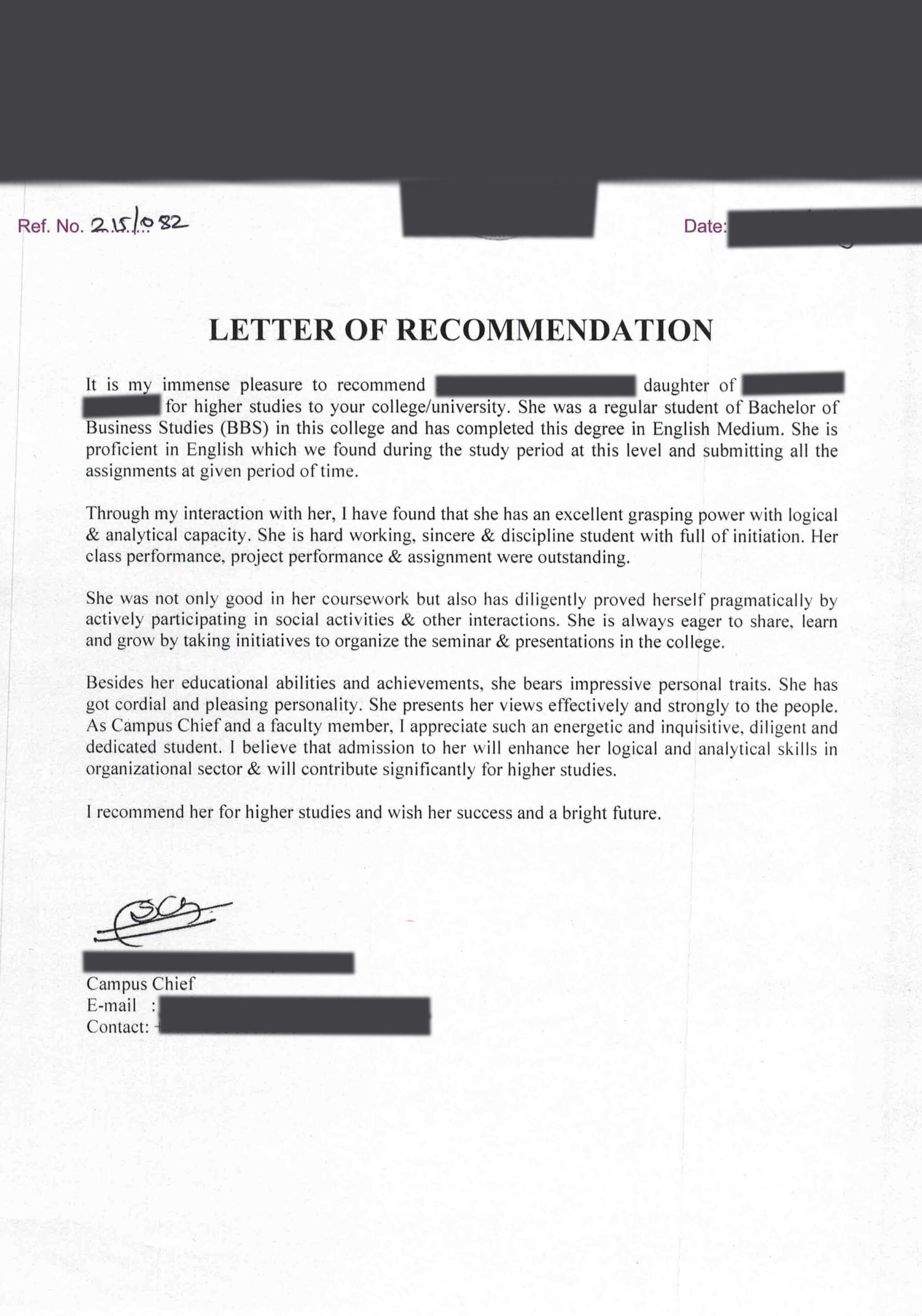
A letter of recommendation looks like:
To Whom It May Concern,
I am pleased to recommend Mr. Suman Sharma, who was my student in the Bachelor of Business Studies (BBS) program at Tribhuvan University. I taught him Business Research Methods and Strategic Management during his final academic years, where he consistently demonstrated excellent analytical skills, discipline, and a strong interest in research-based learning.
During a field research project on consumer buying behavior in Kathmandu, Suman took the lead in designing the survey, collecting data, and presenting the final findings with confidence. His ability to connect theory with real-world business problems clearly showed his academic maturity and readiness for advanced study.
Beyond academics, he has always shown strong leadership, teamwork, communication skills, and professionalism. He is highly motivated, responsible, and committed to achieving his long-term educational goals.
Based on his academic strengths, work ethic, and future potential, I strongly recommend him for admission to your Master’s program in Business Analytics. I am confident he will make a positive contribution to your university community.
Sincerely,
Dr. Ramesh Adhikari
Associate Professor
Faculty of Management
Tribhuvan University
Kathmandu, Nepal
Email: r.adhikari@tu.edu.np
To Whom It May Concern,
I am pleased to recommend Ms. Aayusha Sharma, who worked as a Digital Marketing Executive at Queens Digital Agency for the past two years. During her time with our company, she consistently demonstrated strong analytical thinking, creativity, leadership potential, and excellent communication skills.
Aayusha played an important role in managing SEO content campaigns, coordinating with designers and developers, and improving client campaign performance through data-driven strategies. Her ability to take ownership of projects, solve problems independently, and collaborate effectively with the team made her one of our most reliable professionals.
She has shown exceptional commitment to continuous learning and professional growth, which is why I strongly believe she is well-suited for advanced studies in Marketing Analytics and Business Strategy. Her practical experience, discipline, and strategic mindset will help her perform well in an international academic environment.
I strongly recommend her for admission to your graduate program and am confident she will make a valuable contribution to your institution.
Sincerely,
Chitra Raj Bhandari
Head of Digital Marketing
Queens Digital Agency
Kathmandu, Nepal
Email: info@queensdigital.com.np
Common mistakes you should avoid in a recommendation letter include choosing the wrong recommender, asking too late, using a generic copied template, mentioning the wrong university or course, missing the deadline, and failing to include specific examples that genuinely support the applicant’s strengths.
A strong recommendation letter can make a real difference in your study abroad application, especially when it aligns well with your SOP, academic profile, and future career goals. If you are unsure who to ask, what format to use, or how to make your letter stronger for university admission or scholarship applications, getting expert guidance can help avoid costly mistakes.
At Goreto, we help Nepali students prepare complete study-abroad document sets, including recommendation letters, SOPs, CVs, transcripts, and university application support, so every part of your profile tells one strong, credible story.
Most universities ask for 1 to 3 letters of recommendation, depending on the course and level of study. Bachelor’s programs may require 1–2, while Master’s, MBA, and PhD applications often require 2–3 strong letters of recommendation.
The best person to write your recommendation letter is someone who knows your academic performance, research work, or professional skills closely, such as a professor, thesis supervisor, employer, or direct manager.
Yes, an employer recommendation letter is highly useful for MBA, management, leadership, and professionally oriented Master’s programs, especially if you have work experience or a study gap.
A strong recommendation letter includes the recommender’s relationship to you, specific examples of your strengths, academic or professional achievements, personal qualities, and a clear final endorsement of your candidacy for the program.
It is best to ask for a recommendation letter at least 2–3 weeks before the application deadline so the recommender has enough time to write a thoughtful, personalized, and well-structured letter.
Important guidance note
This page provides general guidance about studying abroad. Requirements, fees and policies can change. For advice about your situation, speak with a Goreto counsellor before applying.
Book Your Free Consultation
From choosing the right country to finding scholarships and housing, our counselors will guide you at every step.
Choose the right country based on your goals
Find courses that match your career plan
Get guidance on colleges and universities
Plan your finances, scholarships & part-time jobs
Plan your abroad stay & post-study plan

Schedule a free consultation with our expert counselors to discuss your study

Schedule a free consultation with our expert counselors to discuss your study