

Dhiraj Kandel
Managing DirectorSchedule a free consultation with our expert counselors to discuss your study
Getting accepted by a Canadian college or university is only one part of your study journey. You must also follow Canada student visa rules because IRCC checks whether your documents, funds, study purpose, course choice, and future plan make sense.
For Nepali students, a Canadian student visa usually means an application for a study permit. A study permit allows you to study in Canada, while a visa or eTA may allow you to enter Canada. IRCC, the Canadian immigration authority, decides whether your application proves that you are a genuine student.
This guide explains the main Canada study permit rules, Canada student visa requirements, document rules, SOP expectations, financial requirements, PAL/TAL requirements, and post-arrival conditions.
Students must be accepted by a valid Designated Learning Institution, submit a genuine Letter of Acceptance, provide sufficient proof of funds, state a clear study purpose, include a PAL or TAL if required, complete biometrics and medical requirements, if applicable, and comply with all study permit conditions after approval.
In short, IRCC wants to see that:
IRCC may refuse a study permit if the applicant does not have a valid Letter of Acceptance, does not show enough money, does not pass the medical exam if required, does not convince the visa officer that the main purpose is to study, or does not convince the officer that they will leave Canada at the end of the authorized stay.
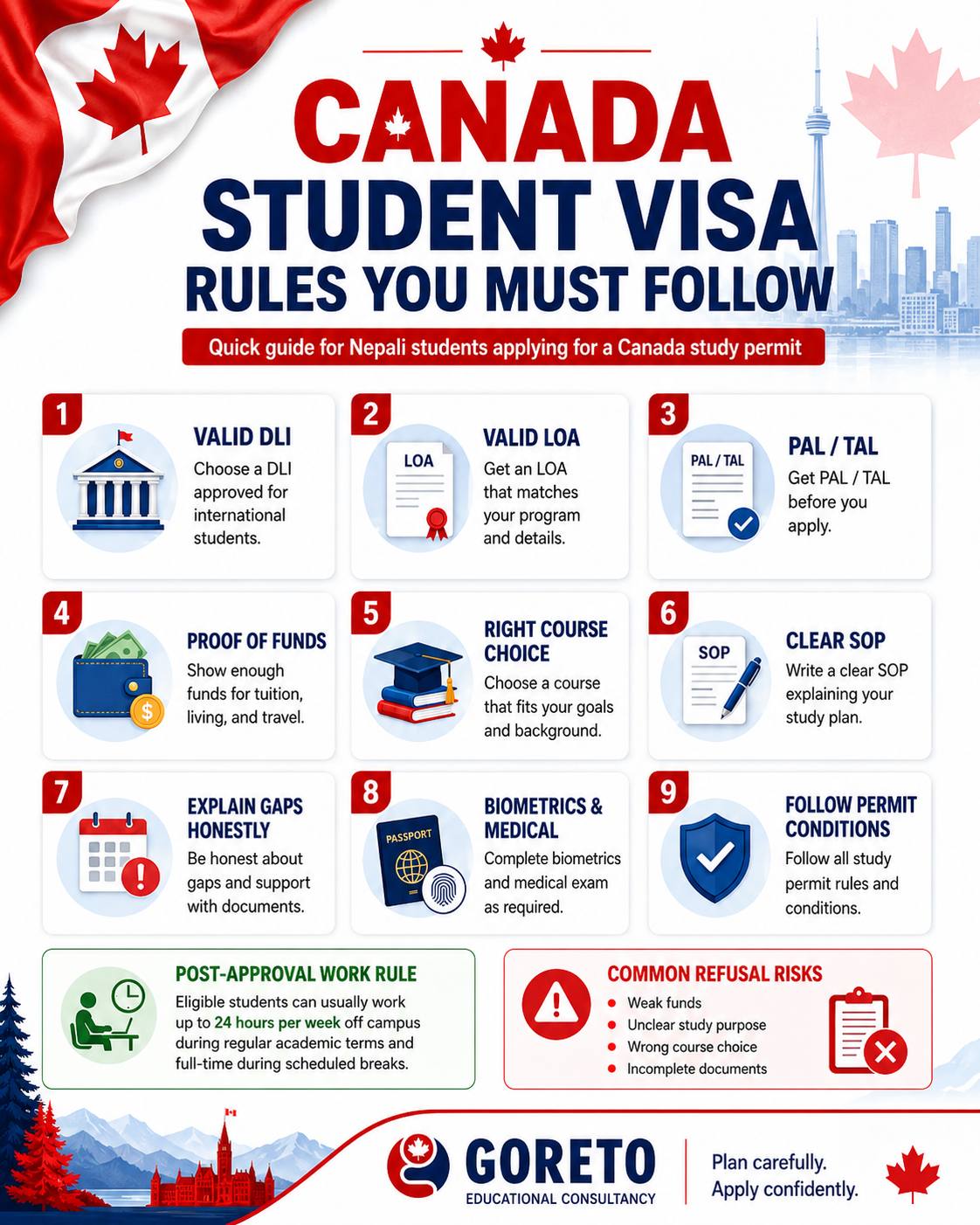
A Designated Learning Institution, or DLI, is a Canadian school approved by a provincial or territorial government to accept international students. For most Nepali students, choosing a valid DLI is one of the first and most important steps in the Canada student visa process.
A study permit is meant for students who plan to study at an approved DLI in Canada. This means students should not choose a college or university only because it is cheap, popular, or recommended by someone. The institution must be officially eligible to host international students, and students should always check the DLI status before applying.
Before applying, students should check:
A non-DLI or invalid institution choice can create serious problems for study permit eligibility. Students should always verify the DLI status before paying tuition or preparing the visa file.
A Letter of Acceptance, often called an LOA, is one of the most important documents for a Canadian student visa. You must get a Letter of Acceptance from your school and upload it to the online study permit application. For post-secondary students, the school may be asked to confirm that the LOA is valid.
Your LOA should match your actual study plan. Check details such as:
For example, if your SOP states you are applying for a business diploma in Ontario, but your LOA lists a different program, province, or intake, it can cause confusion. The visa officer should be able to clearly understand your study plan from your LOA, SOP, academic documents, and financial documents.
Many students now need a Provincial or Territorial Attestation Letter before applying for a Canadian study permit. A PAL or TAL is issued for the province or territory where the student plans to study and confirms that the student is included under that province or territory’s international student allocation.
A PAL/TAL is not the same as a college offer letter. It is a separate document required for many study permit applications. You will usually receive guidance about the PAL/TAL process from your Designated Learning Institution, so you should check with your college or university before submitting the visa application.
When applying for a Canada study permit, you should prepare your Letter of Acceptance, PAL/TAL if required, and all other supporting documents needed for a complete application. Missing this requirement can delay the process or weaken the application, so Nepali students should confirm whether they need a PAL or TAL before applying.
Proof of funds is one of the most important requirements for a Canadian study permit. You must demonstrate that you have sufficient funds to cover tuition fees, living expenses, travel costs, and the overall cost of study in Canada without relying on work.
For applications submitted on or after September 1, 2025, the living expense requirement for one person is listed as CAN$22,895 for the first year outside Quebec. This amount does not include tuition and travel costs, so you should check the latest official amount before applying.
For Nepali students, the source of money is very important. A high bank balance alone may not be enough if the funds are not clear. Bank statements, sponsor income documents, tax records, proof of business income, loan approval, tuition receipts, scholarship letters, or GIC documents can help demonstrate that the money is genuine and explainable.
Course selection is one of the most common areas where Nepali students make mistakes. The best course in Canada should align with your prior education, work experience, skills, and future career goals.
Visa officers want to understand why you chose that program and why it makes sense for your future. A course does not always need to be exactly the same as your past subject, but the connection should be logical and clearly explained.
| Student Profile | Strong Course Choice | Weak Course Choice |
| +2 Management student | Business diploma, accounting, marketing, hospitality management | Unrelated technical course with no explanation |
| Bachelor’s in IT | Cybersecurity, data analytics, software development, cloud computing | Basic diploma that repeats previous study |
| Nursing background | Health administration, public health, healthcare leadership | Random business course without a career link |
| Work experience in the hotel sector | Hospitality, tourism management, culinary management | Program unrelated to experience or goals |
A weak course choice does not always mean automatic rejection, but it must be explained carefully. If the program appears to be a shortcut to entering Canada rather than a genuine study plan, the application becomes weaker.
Your Statement of Purpose, or SOP, is where you explain your study plan in your own words. A copied, generic, or over-polished SOP can weaken the application because it does not show your real story.
A good SOP for a Canada student visa should explain:
IRCC recommends a letter of explanation where students explain why they want to study in Canada and confirm that they understand their responsibilities as international students. Your SOP should sound like a real student wrote it. It should not exaggerate, copy from online samples, or make promises unsupported by documentation.
A study gap or previous visa refusal does not automatically mean rejection. Many students with gaps or refusals still successfully reapply when their new application is stronger, clearer, and more complete.
The rule is simple: be honest.
If you have a study gap, explain what you were doing during that time. Depending on your situation, supporting documents may include:
If you had a previous refusal, do not hide it. Explain what happened and how your new application addresses the earlier concern.
For example, if the refusal was due to weak funds, the new file should include stronger financial proof. If the issue was unclear study purpose, the SOP and course selection should be improved.
After submitting a Canada student visa application, students may need to complete biometrics and medical requirements. Biometrics includes fingerprints and a photo, and students should book their biometrics appointment as early as possible to avoid processing delays.
Some applicants may also be asked for extra information, an interview, a police certificate, or a medical exam. For Nepali students, an immigration medical exam is usually required because Nepal is listed as a country subject to medical examination requirements. Students planning to study in Canada for more than six months should complete the required medical steps properly and follow all instructions given during the application process.
Getting a Canada student visa approved is not the final step. After arriving in Canada, students must comply with the conditions stated on their study permit. These conditions may include the level of study, whether the student can work on or off campus, medical reporting requirements, travel rules within Canada, and the date they must stop studying.
Students should follow rules such as:
Eligible students can usually work up to 24 hours per week off campus during regular academic terms and full-time during scheduled breaks. Part-time jobs in Canada can help international students manage daily expenses, gain Canadian work experience, improve communication skills, and build confidence while studying. Working more than the allowed hours can break study permit conditions and may affect student status or future visa applications.
The study permit expiry date is also very important. It shows when the student must stop studying and leave Canada, unless they apply for an extension. In most cases, the expiry date is based on the length of the study program plus 90 days, so students who want to continue studying must apply for an extension before their permit expires.
Before applying, verify the latest IRCC rules, especially the Canada study permit PAL requirement, proof-of-funds amounts, work-hour conditions, medical rules, biometrics steps, and Canada student visa 2026 rules.
Need help checking your profile, documents, SOP, PAL/TAL requirement, or previous refusal? Speak with an experienced study abroad advisor at Goreto Educational Consultancy. Proper guidance cannot guarantee approval, but it can reduce avoidable mistakes and help you submit a stronger application.
Many Nepali students applying for undergraduate, diploma, or college-level programs may need a Provincial Attestation Letter or Territorial Attestation Letter before submitting a Canada study permit application. Some students, such as eligible master’s and PhD applicants, may be exempt, so students should always check the latest rules before applying.
For a Canadian student visa, students must demonstrate sufficient funds for tuition fees, living expenses, and travel costs. The living expense amount for one person outside Quebec is listed as CAN$22,895 for the first year, excluding tuition and travel. Students should verify the latest amount before applying.
No, students should apply to a valid Designated Learning Institution if they want to study in Canada with a study permit. A DLI is a school approved to host international students. Choosing a non-DLI can create serious problems for study permit eligibility.
A study gap does not automatically lead to refusal, but it must be explained clearly. Students should provide supporting documents, such as work experience letters, training certificates, business records, medical documents, or explanations of family responsibilities, where relevant.
Breaking Canada student visa rules can affect student status, future visa applications, work eligibility, and the ability to stay in Canada. Common violations include unauthorized work, not actively studying, overstaying after a permit expires, or submitting false documents.
Changing colleges may be possible, but students must follow the latest IRCC rules and make sure the new institution is also a valid DLI. Students should check whether changing schools or programs affects their study permit conditions before making the change.



From choosing the right country to finding scholarships and housing — our counselors will guide you at every step.
Choose the right country based on your goals
Find courses that match your career plan
Get guidance on colleges and universities
Plan your finances, scholarships & part-time jobs
Plan your abroad stay & post-study plan

Schedule a free consultation with our expert counselors to discuss your study

Schedule a free consultation with our expert counselors to discuss your study