

Dhiraj Kandel
Managing DirectorSchedule a free consultation with our expert counselors to discuss your study
A house rent agreement is a written contract between a property owner and a tenant. For study abroad purposes, Nepali students usually use it to support a sponsor’s rental income as part of financial proof. The agreement works best when it matches other documents such as Lalpurja, bank statements, tenant ID, and tax records.
This document is usually not enough on its own, but it can be a valuable supporting paper in your financial file. When combined with ownership papers, bank statements, tax documents, and sponsor details, it can make your application more complete and more believable.
A house rent agreement is a formal, written document that shows that a house, flat, room, building, or land has been rented to someone in exchange for rent. It clearly mentions who owns the property, who is renting it, how much rent is being paid, and for how long.
In simple words, it is proof that a property is being rented and that rental income is being generated from it. For students, this matters because some visa or university applications look closely at where the sponsor’s money comes from. If your father, mother, guardian, or other sponsor earns income from property rent, the agreement helps explain that source of income.
Why it matters for documentation
A rent agreement can help connect the full financial story. It supports questions like:
A house rent agreement is important for study abroad applications because it shows that the rental income used for your financial proof is genuine, regular, and supported by legal documents. This helps visa officers better understand the source of your income and makes your financial documents more credible.
To make a house rental agreement in Nepal for study abroad purposes, prepare a written agreement between the house owner and tenant that clearly states the property details, rent amount, rental period, and both parties’ identification documents. Then sign it and, if needed, have it notarized.
Start by gathering papers that prove the sponsor owns the property. In Nepal, this usually means:
This step is important because a rent agreement is stronger when the owner in the agreement matches the owner in the property document.
The agreement should clearly mention who the tenant is. Gather:
This helps avoid weak or incomplete documentation. In many cases, tenant citizenship and the rent agreement Nepal should match properly for the file to look genuine.
Use simple and formal wording. Make sure the agreement includes:
The monthly rent should be realistic and consistent with the property type and location. The duration should also be clear.
For example:
Do not mention random or inflated amounts just to make the sponsor look stronger. If the amount appears unrealistic and there is no supporting bank trail, it can weaken the file.
A proper agreement should include:
This makes the document look more formal and complete.
This is one of the most important steps. A rent agreement alone is not enough. You should also gather:
This is where sponsor rental income documents in Nepal become important. The goal is to show that the rental income is not just written on paper but also supported by financial records.
If any supporting papers are in Nepali and your consultant, university, or visa process requires an English explanation, keep a translated or clearly labelled copy ready. Also, organize the file properly:
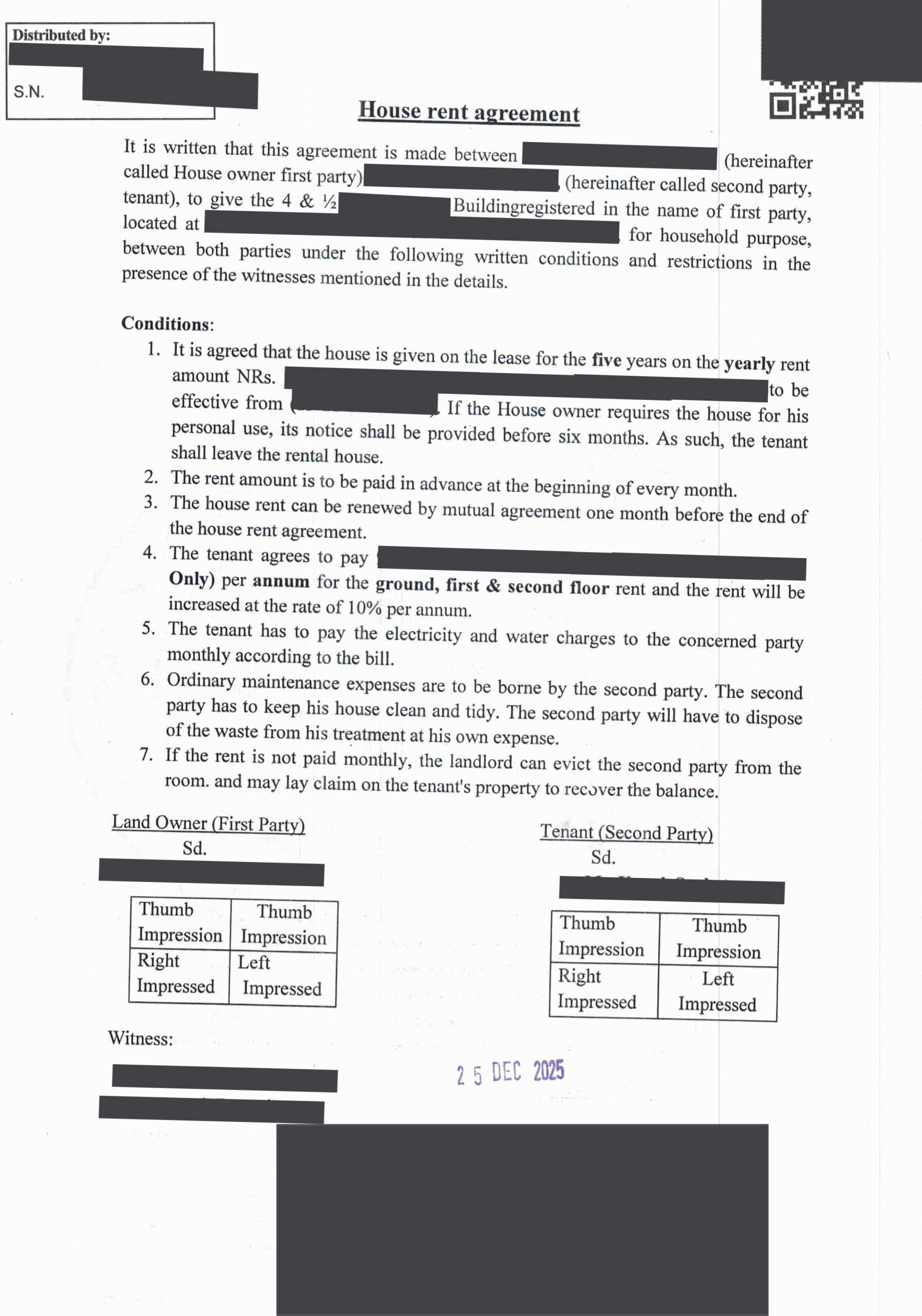
Below is a simple sample format for learning purposes. It should be edited according to real details and reviewed properly before use.
Regd. No. 412/81
House Rent Agreement
This House Rent Agreement is made on this [day] of [month], [year], between Mrs. [First Party Name], aged [xx] years, holder of Citizenship Certificate No. [xxxxxxxx], daughter of [father’s name], wife of [husband’s name], and a permanent resident of [full address], herein after referred to as the “First Party”, and Mr. [Second Party Name], aged [xx] years, holder of Citizenship Certificate No. [xxxxxxxx], son/grandson of [family details], and a permanent resident of [full address], hereinafter referred to as the “Second Party”.
Whereas the First Party is the lawful owner of a residential house situated at [property address], and has agreed to let out the said house/room to the Second Party for residential purposes only, both parties have mutually agreed to enter into this agreement under the following terms and conditions and have signed this deed in two equal original copies, one for each party.
Conditions:
First Party: Second Party:
Name: _______________________ Name: _______________________
Address: _____________________ Address: _____________________
Signature: ___________________ Signature: ___________________
Thumb Impression Affixed Thumb Impression Affixed
Witnesses:
Address: ____________________
Signature: __________________
Address: ____________________
Signature: __________________
Prepared By:
Name: ______________________
Designation: Advocate / Legal Consultant
License No.: __________________
Address: _____________________
Signature/Stamp: ______________
Date: ______________________
Place: ______________________
Supporting documents needed with a house rent agreement usually include the Lalpurja, sponsor, and tenant citizenship, bank statements showing rent deposits, tax records, and any relationship or explanation documents that support the income source.
A Lalpurja, or House Ownership Certificate, helps prove that the sponsor legally owns the property being rented out. Without proof of ownership, the rent agreement alone may not be enough, because anyone can draft one on paper. The ownership certificate gives the agreement legal and practical backing.
If the property is registered under the sponsor’s name, this document directly supports the claim that the rent is genuine. If the property is jointly owned, it is better to include any additional ownership documents that clearly explain the ownership structure.
The sponsor’s citizenship is necessary because it identifies the person claiming the rental income. In a study abroad application, identity consistency matters a lot. The same name should ideally appear across the rent agreement, ownership papers, bank statements, tax papers, and sponsorship documents.
This document helps connect the sponsor to the property and to the student’s financial support. It also becomes more important when the sponsor is not the student’s parent, as the visa officer may scrutinize the financial relationship and the source of income more closely.
The tenant’s identity document is another useful supporting document. If the tenant is an individual, a copy of the tenant’s citizenship document can help verify that the person named in the agreement is real and identifiable. If the tenant is a business, then company registration documents can serve the same purpose.
A rent agreement may say that the tenant pays monthly rent, but the bank statement helps prove that the money is actually being received. This is why regular rent deposits in the sponsor’s bank account are so valuable.
This document helps answer one of the biggest questions in a visa file: Is this income real and active, or is it only claimed on paper? The statement should ideally show a pattern that matches the agreement, such as monthly deposits over time. If the tenant pays by bank transfer, the file becomes even stronger.
Tax-related documents can make the rental income claim much more credible. If the sponsor has paid tax on rental income, or if rental earnings are reflected in their tax records, that adds a strong layer of legitimacy to the file. It shows that the income is not only being received but also properly declared.
Property tax receipts are not always the first document people think about, but they can still be very useful. These receipts help demonstrate the property’s existence and active use. They also add another document that connects the sponsor to the house or building mentioned in the agreement.
If the sponsor is not the student’s father or mother, a relationship certificate becomes very important. For example, if the sponsor is an uncle, aunt, brother, sister, grandfather, or another relative, the student should normally include proof of their relationship.
Sometimes a short explanation letter can make the entire file easier to understand. This is especially helpful when the sponsor has multiple income sources, when rent is only part of the total financial picture, or when some documents need context.
For example, the letter can briefly explain:
Different countries may look at financial documents differently. The main rule is simple: your papers should be believable, consistent, and supported by evidence. Also, specific visa document expectations can change, so students should always verify the latest checklist, embassy guidance, or consultant advice before final submission.
A house rental agreement for Australia visa purposes can support the sponsor’s rental income, but it should also include proof of ownership, the tenant’s ID, bank statements, tax documents, and the sponsor’s identity documents. Most importantly, all documents must clearly match, and the latest Australian visa financial checklist should always be verified before submission.
For Canada, a house rental agreement should be included in a complete financial file that demonstrates the sponsor’s rental income is real and traceable through ownership documents, bank deposits, tax records, and a clear supporting explanation. The agreement alone is usually not enough, so it works best when combined with the full set of financial documents.
For the UK, students should also focus on clear and consistent financial paperwork. If rental income is mentioned in the overall sponsor profile, it should be supported by documentation. The safest approach is to avoid unsupported claims. If the sponsor’s income includes rent, the document file should clearly show the source.
Mistakes Nepali students and sponsors make include submitting only the rent agreement without proof of ownership, omitting bank deposit records, name mismatches across documents, and failing to clearly explain the sponsor’s relationship and income source.
A well-prepared rent agreement file can make your study abroad financial documents clearer and more credible. Get expert guidance to organize your ownership papers, bank statements, and sponsor documents properly before final submission.
No, a house rent agreement alone is usually not enough; it should be supported by Lalpurja, bank statements, tenant ID, and sponsor documents for stronger financial proof.
Important supporting documents include proof of ownership, the sponsor’s citizenship, the tenant’s ID, bank deposit records, tax documents, and, if the sponsor is not a parent, a relationship certificate.
Yes, rental income can be used if it is clearly traceable through ownership papers, regular bank deposits, and matching financial records.
The rent amount should be realistic based on the property type and location, and it must match the deposits shown in the sponsor’s bank statements.
From choosing the right country to finding scholarships and housing — our counselors will guide you at every step.
Choose the right country based on your goals
Find courses that match your career plan
Get guidance on colleges and universities
Plan your finances, scholarships & part-time jobs
Plan your abroad stay & post-study plan

Schedule a free consultation with our expert counselors to discuss your study

Schedule a free consultation with our expert counselors to discuss your study