

Dhiraj Kandel
Managing DirectorSchedule a free consultation with our expert counselors to discuss your study
Some commonly affordable universities in Australia for international students include Southern Cross University, University of Southern Queensland, University of New England, Charles Darwin University, Central Queensland University, Federation University Australia, University of the Sunshine Coast, Western Sydney University, Victoria University, and Australian Catholic University.
Choosing from the cheapest universities in Australia for international students can help reduce your study budget, but the cheapest option is not always the best option. A university should only be considered affordable if the course is suitable, the location is manageable, the tuition fee fits your budget, the admission requirements are realistic, and the overall cost supports your long-term career goals.
The universities below are often considered by students searching for affordable universities in Australia for international students. The tuition ranges are approximate and, where available, based on official university fee information. Always check the current course page before applying.
| University | Location | Popular courses | Annual tuition | Why is it affordable | Best suited for |
| Southern Cross University | Gold Coast, Lismore, Coffs Harbour, other campuses | Business, IT, education, engineering, health | Around AUD 26,000 for many of the listed 2026 courses. | 2026 international guide’s programs have comparatively lower tuition fees. | Students looking for regional or coastal study options |
| University of Southern Queensland | Toowoomba, Springfield, Ipswich | Business, IT, education, engineering, health | AUD 28,000–39,500+ per year, course-dependent. | Some business and education courses’ fees are cheaper and reviewed annually. | Students comparing regional study with practical course options |
| University of New England | Armidale, Sydney | Arts, business, IT, education, science, nursing | AUD 27,300–38,400 for many listed 2026 course examples. Tuition only. | Regional location and a wide range of course options. | Students who want regional study and flexible course choices |
| Charles Darwin University | Darwin and other study locations | Business, IT, engineering, health, education | AUD 31,000–39,500 for selected listed 2026 course examples. | Suitable for students looking beyond Sydney and Melbourne. | Students interested in Northern Australia and practical career courses |
| Central Queensland University | Multiple campuses across Australia | Business, IT, engineering, nursing, education | Unit-based fee schedule. Exact fee depends on enrolled units and discipline. | Multiple campus options to help compare tuition and living costs. | Students who want campus flexibility |
| Federation University Australia | Ballarat, Berwick, Gippsland, Brisbane and other locations | Business, IT, education, health, and engineering | Approx. AUD 31,800–44,200 for listed 2026 higher education examples. | Programs outside health, IT, and engineering areas are affordable. | Students comparing regional and metropolitan options |
| University of the Sunshine Coast | Sunshine Coast, Moreton Bay and other locations | Business, arts, psychology, science, health | AUD 28,500–32,500+ for selected 2026 programs. | A regional Queensland location helps manage lifestyle and living costs. | Students looking for Queensland study options outside inner-city areas |
| Western Sydney University | Western Sydney | Business, IT, health, engineering, social sciences | AUD 32,500–42,118 for many undergraduate courses. Specialised courses are higher. | Scholarships are available for eligible international students. | Students who want Sydney access with a Western Sydney location |
| Victoria University | Melbourne, Sydney, Brisbane | Business, IT, education, health, and sport | AUD 33,000–40,800 for many international programs in Sydney and Brisbane. | Scholarships reduce first-year tuition for eligible international students. | Students looking for practical study models and city campuses |
| Australian Catholic University | Sydney, Melbourne, Brisbane, Canberra, Ballarat and others | Nursing, education, business, allied health, and arts | AUD 28,648–52,544. Some business, education, IT, and nursing courses cost AUD 34,968–39,280. | Fees are fixed for minimum course durations, so you can plan expenses clearly. | Students interested in education, nursing, health, and values-based study environments |
Affordable universities in Australia for international students should be compared based on total study costs, not tuition alone. A university with slightly higher tuition may become cheaper overall if it offers scholarships, lower living costs, better access to part-time work, or a shorter course structure.
Tuition fees form the largest study cost for most international students. Universities charge different fees for bachelor’s degrees, master’s degrees, diploma pathways, and postgraduate certificates.
Tuition fees for Australian courses vary by city, program, provider, and study level, and students may also need to budget for additional materials or equipment.
A low-cost university is useful only when it offers the right course. Course selection should align with your academic background, career goals, and visa statement.
The cost of living in Australia can vary by city, accommodation type, lifestyle, and transport needs. It is recommended to use official cost tools as a guide, as actual costs can be higher or lower depending on students’ choices. For example, a university with slightly higher tuition in a more affordable city may sometimes be cheaper overall than a low-tuition university in an expensive rental area.
Students should not choose a course only because it is cheap. A course should also align with your career plan, prior education, financial capacity, and future opportunities. For Nepali students, this is important because your course selection may also affect the strength and credibility of your student visa application.
Scholarships can reduce tuition costs, but students should not assume they will receive one. Each scholarship has its own eligibility rules, deadline, academic criteria, and application process.
Regional universities can be more affordable because they may be located in cities with lower rent, lower transport costs, and smaller student expenses than in major metropolitan areas. Regional universities may also offer strong support services and practical courses for international students.
Regional study can help students in 3 ways:
Regional does not always mean cheap. Some regional courses can still have high tuition, placement costs, or limited part-time work options. Students should compare both tuition and living expenses before choosing a regional university.
When comparing the cost of studying in Australia for international students, tuition fees are only one part of the budget. Students must also think about living costs, OSHC, visa-related costs, and study materials.
| Cost factor | What students should know |
| Tuition fees | Depends on the university, course, level, campus, intake, and study load. Always verify from the official course page. |
| Accommodation | Can vary widely by city, suburb, room type, shared housing, homestay, or student accommodation. |
| Food and groceries | Depends on lifestyle, cooking habits, and location. Students should budget realistically. |
| Transport | Depends on the city, distance from campus, and public transport options. |
| OSHC | International students must maintain Overseas Student Health Cover for the duration of their study in Australia. |
| Study materials | Some courses may require textbooks, uniforms, tools, software, placement checks, or equipment. |
| Visa-related costs | May include student visa subclass 500 application charges, health checks, biometrics, English tests, document translation, and other preparation costs. Always verify from official sources. |
Students applying for a student visa should also understand financial capacity requirements. Australia increased the minimum funds required for student visa applicants in May 2024, but this figure should always be rechecked before lodging, as visa rules can change.
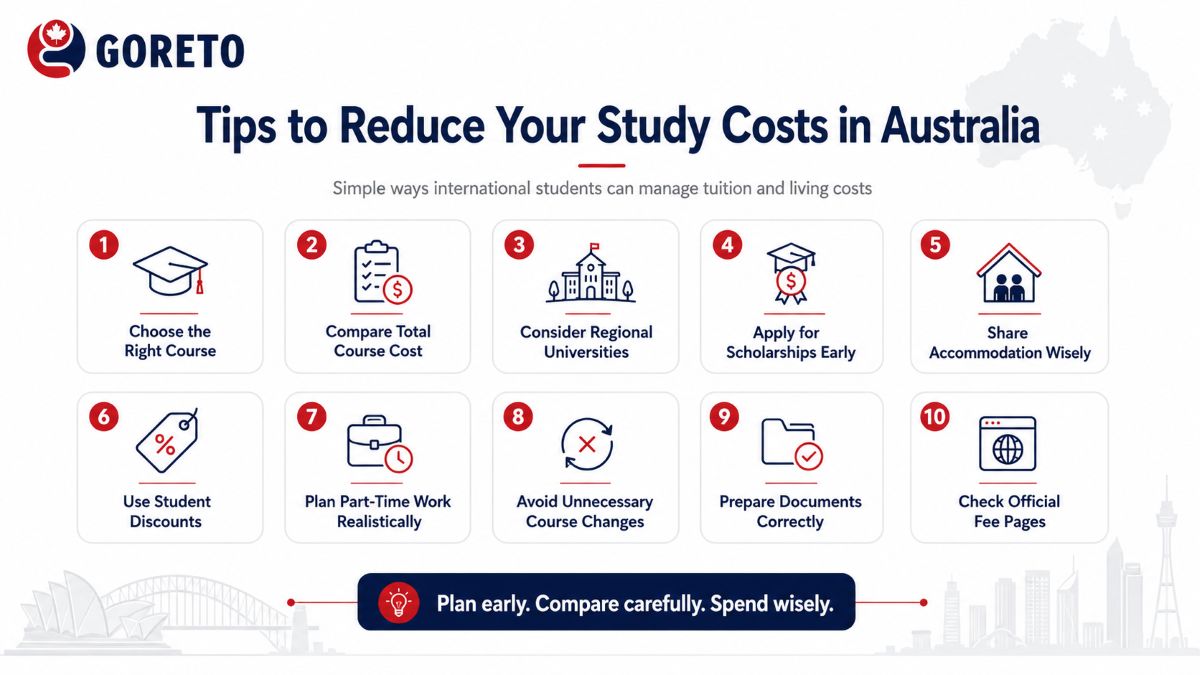
You can reduce study costs by planning early and comparing every major expense before accepting an offer.
No, the cheapest university in Australia is not always the best option. You should not choose only based on tuition fees. Course quality, graduate outcomes, location, student support, visa credibility, and long-term career goals matter.
A low tuition fee may create problems when:
A good university choice balances low tuition with academic fit, job prospects, student support, and realistic living costs in the region.
Finding the cheapest universities in Australia is a good starting point, but you should look beyond tuition fees. The best university is one that aligns with your budget, location preferences, admission profile, and long-term career plan.
Goreto Educational Consultancy can help you find universities you can afford, understand course options, check admission requirements, and properly prepare your student visa documents. Speak with our team to choose a study plan that fits your goals and budget.
Some affordable universities in Australia for international students include Southern Cross University, University of Southern Queensland, University of New England, Charles Darwin University, Central Queensland University, Federation University Australia, University of the Sunshine Coast, Western Sydney University, Victoria University, and Australian Catholic University.
The cost of studying in Australia depends on the university, course, city, lifestyle, accommodation, and visa-related expenses, which are typically around AUD 20,000 to AUD 50,000. Students should budget for tuition fees, living costs, OSHC, transport, food, study materials, and student visa expenses. Tuition is usually the highest cost, but living expenses can also make a major difference in the total study budget.
Regional universities can sometimes be more affordable because rent, transport, and daily living expenses may be lower than in major cities like Sydney or Melbourne. However, regional does not always mean cheap. Students should compare tuition fees, living costs, course availability, part-time work options, and student support before choosing a regional university.
There is no single cheapest university for all Nepali students because fees depend on the chosen course, study level, campus, and intake. A university may be affordable for business or education, but more expensive for nursing, engineering, IT, or health courses. Nepali students should compare the total cost of the course, admission requirements, scholarship options, visa suitability, and long-term career goals before applying.
No, international students should not choose a university only because it has low tuition fees. The course should match the student’s academic background, career goals, financial capacity, and visa plan. A slightly more expensive university may be a better option if it offers the right course, a better location, stronger student support, scholarship opportunities, and better career outcomes.
From choosing the right country to finding scholarships and housing — our counselors will guide you at every step.
Choose the right country based on your goals
Find courses that match your career plan
Get guidance on colleges and universities
Plan your finances, scholarships & part-time jobs
Plan your abroad stay & post-study plan

Schedule a free consultation with our expert counselors to discuss your study

Schedule a free consultation with our expert counselors to discuss your study