

Dhiraj Kandel
Managing DirectorSchedule a free consultation with our expert counselors to discuss your study
A land lease agreement is a written contract between a landowner and a person who uses the land for farming or other agreed-upon purposes. For study abroad purposes, Nepali students usually use it to support a sponsor’s agriculture-based income as part of financial proof. The agreement works best when it matches other documents such as Lalpurja, bank statements, tenant or lessee ID, land tax records, and sponsor documents.
This document is usually not enough on its own, but it can be a valuable supporting paper in your financial file. When combined with ownership papers, bank statements, sponsor details, proof of rent or lease payments, and an explanatory letter, these can make your application more complete and more believable.
A land lease agreement is a formal, written document that shows that land has been granted to another person for use in exchange for money or other agreed-upon compensation. It clearly states who owns the land, who is leasing the land, how much the lease payment is, and for how long.
A land lease agreement is proof that land is being leased and that income is being generated from it. For students, this matters because some visa or university applications look closely at where the sponsor’s money comes from. If your father, mother, guardian, or other sponsor earns income from leased agricultural land, the agreement helps explain that source of income.
A land lease agreement is important for study abroad applications because it demonstrates that the lease income used as proof of funds is genuine, regular, and well-documented. This helps visa officers better understand the source of your income and makes your financial documents more credible.
To make a land lease agreement in Nepal for study abroad purposes, prepare a written agreement between the landowner and the tenant or lessee that clearly states the land details, lease amount, lease period, and both parties’ identification details.
Start by gathering papers that prove the sponsor owns the land. In Nepal, this usually means:
This step matters because a lease agreement looks much stronger when the owner named in the agreement matches the owner named in the land document.
The agreement should clearly mention who the tenant or lessee is. Gather:
This helps avoid weak or incomplete documentation. In many cases, the lessee’s citizenship and the lease agreement should align for the file to appear genuine.
Use simple and formal wording. The land lease files should include the parties, proof of ownership, signatures or finger stamps, and other supporting records. Make sure the agreement includes:
The lease amount should be realistic and consistent with the land type, size, location, and use. The duration should also be clear.
Do not mention random or inflated amounts just to make the sponsor look financially stronger. A stronger file is one in which the agreed amount matches the sponsor’s bank records and other financial documents.
For example:
A proper agreement should include:
This is one of the most important steps. A land lease agreement alone is not enough. You should also gather:
For lease income, it is generally better to include the property owner’s bank statements from the last 12 months showing lease deposits or receipts, along with land tax receipts. In many cases, 6 to 12 months of bank statements, supported by ward or municipality verification where available, can make the financial file clearer and more reliable.
If any supporting papers are in Nepali and your university, consultant, or visa process requires English, keep translated copies ready. Australia says students must provide English translations of all non-English supporting documents and include translator details.
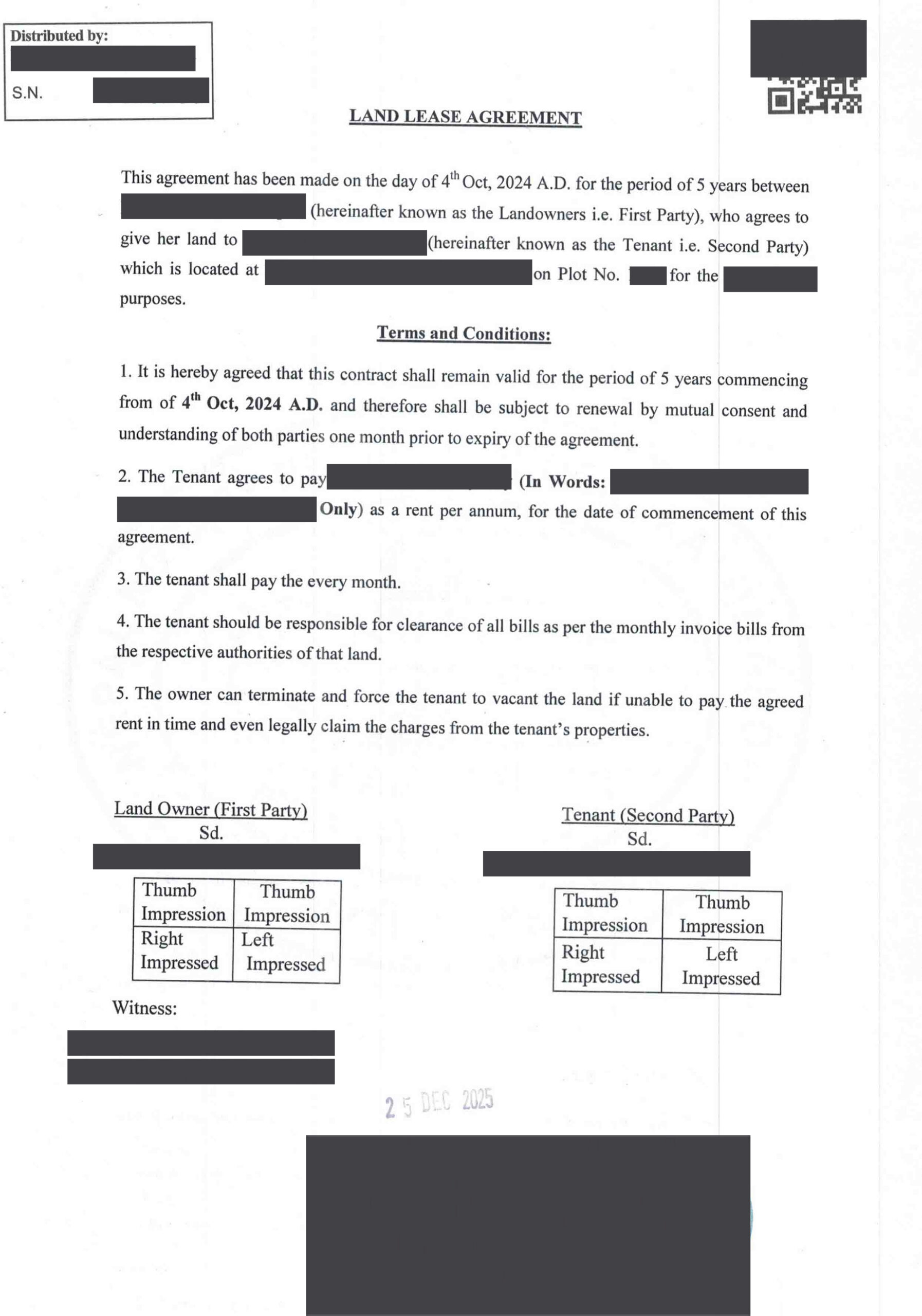
Below is a simple sample format for learning purposes. It should be edited according to real details and reviewed properly before use.
Regd. No. 412/81
Land Lease Agreement
This Land Lease Agreement is made on this [day] of [month], [year], between Mr./Mrs—[First Party Name], aged [xx] years, holder of Citizenship Certificate No. [xxxxxxxx], resident of [full address], hereinafter referred to as the “First Party”, and Mr./Mrs./Company [Second Party Name], holder of Citizenship Certificate No./Registration No. [xxxxxxxx], resident of [full address], hereinafter referred to as the “Second Party.”
Whereas, the First Party is the lawful owner of the land situated at [district/municipality/ward/location], having plot details [kitta number/area if applicable], and has agreed to lease the said land to the Second Party for [farming/commercial/storage/other lawful purpose], both parties have mutually agreed to enter into this agreement under the following terms and conditions.
Conditions:
First Party:
Name: _____________________
Address: __________________
Signature: _________________
Second Party:
Name: _____________________
Address: __________________
Signature: _________________
Witnesses:
Prepared By:
Name: _____________________
Designation: Advocate / Legal Consultant
Signature/Stamp: ___________
Date: __________________
Place: _________________
Supporting documents needed with a land lease agreement usually include the Lalpurja, sponsor, and lessee’s citizenship, bank statements showing lease deposits, land tax records, and any relationship or explanation documents supporting the income source.
A Lalpurja helps prove that the sponsor legally owns the land being leased out. Without proof of ownership, the lease agreement alone may not be enough, because anyone can draft one on paper. The ownership certificate gives the agreement legal and practical backing.
The sponsor’s citizenship is necessary because it identifies the person claiming the lease income. The same name should ideally appear across the lease agreement, ownership papers, bank statements, tax records, and sponsorship documents. Australia’s Home Affairs also tells students to make sure names and details are correct and consistent
The lessee’s identity document is another useful supporting paper. If the lessee is an individual, a copy of the lessee’s citizenship can help verify that the person named in the agreement is real and identifiable. If the lessee is a business, farm group, or company, then registration documents can serve the same purpose.
A land lease agreement may state that the tenant pays rent or a lease amount, but a bank statement helps prove that the money is actually being received. For a Nepal-based student visa application, it is commonly recommended to provide 6 to 12 months, or 12 months, of bank statements showing rent or lease income.
Tax-related or land-related payment records can make the lease income claim more credible. If the sponsor has documents showing land tax payment or any official land-related records, that adds another useful layer of legitimacy to the file.
A ward office letter or an annual income verification document can help clarify the source of income, especially when the sponsor has multiple income sources or land-based earnings. In many cases, an annual income verification from the ward office or municipality can serve as a useful supporting document to strengthen the overall financial file.
If the sponsor is not the student’s father or mother, a relationship certificate becomes important. For example, if the sponsor is an uncle, aunt, brother, sister, grandfather, or another relative, the student should include proof of that relationship.
Sometimes a short explanation letter can make the entire file easier to understand. This is especially helpful when the sponsor has multiple income sources, lease income is only part of the overall financial picture, or some documents require context.
For example, the letter can briefly explain:
A land lease agreement can be used as a supporting financial document for study abroad, but its usefulness depends on the country and the overall strength of the student’s financial file. In most cases, this document is not treated as a stand-alone proof of funds. Instead, it works better as supporting evidence to explain the sponsor’s source of income.
For Australia, a land lease agreement can support the sponsor’s financial background when the student needs to show that the source of funds is genuine and traceable. Australia’s Student visa requirements focus on whether the applicant has sufficient funds and whether the overall file is credible under the Genuine Student assessment, so lease income is weighted more highly when it is supported by bank deposits, proof of ownership, and matching financial records.
For Canada, a land lease agreement may also be used as a supporting document, but the main concern remains whether the student can clearly demonstrate financial support for study and living costs. A lease agreement can help explain how the sponsor earns income, but it should ideally be supported by bank statements and other documents that clarify the source of funds.
For the UK, the financial requirement is generally more fixed and formula-based. Students usually need to show specific funds for tuition and living costs, and the rules focus more on holding the required amount in the correct form than on using a lease agreement as a primary proof document. As a result, a land lease agreement may have limited value and is usually less important than clear financial evidence that meets the visa rules.
For New Zealand, financial evidence is also important, and the authorities clearly require proof that the student or sponsor has sufficient funds available. Where a third party is supporting the student, Immigration New Zealand asks for evidence that the funds are genuinely theirs, and official guidance identifies bank statements and bank confirmation as key evidence.
In that context, a land lease agreement can help explain the income background, but it is usually stronger as a supporting document than as the primary financial proof.
One of the most common mistakes is assuming that a land lease agreement alone is sufficient to demonstrate financial strength for study abroad. In most cases, the agreement should be supported by other documents such as Lalpurja, bank statements, tax papers, and income verification.
A strong land lease file can make your financial documents easier to understand and more trustworthy. Get the right guidance to organize your lease agreement, Lalpurja, bank statements, and sponsor papers properly before you submit your study abroad application.
No, a land lease agreement alone is usually not enough. It works best when supported by Lalpurja, bank statements showing lease income, the sponsor’s citizenship, tax papers, and other financial documents.
A land lease agreement should ideally be attached with Lalpurja, sponsor citizenship, lessee citizenship, or business registration, bank statements showing lease deposits, land tax papers, and a relationship certificate if the sponsor is not a parent.
Yes, land lease income can be used as supporting financial proof if it is genuine, traceable, and properly supported by ownership papers, bank records, and matching sponsor documents.
It is generally better to show 6 to 12 months of bank statements, and in many cases, 12 months is stronger because it demonstrates that the lease income is regular and credible.
Yes, if the agreement or supporting documents are in Nepali, it is safer to have an English translation ready, as universities, visa teams, or consultants may require clear English versions of the documents.
From choosing the right country to finding scholarships and housing — our counselors will guide you at every step.
Choose the right country based on your goals
Find courses that match your career plan
Get guidance on colleges and universities
Plan your finances, scholarships & part-time jobs
Plan your abroad stay & post-study plan

Schedule a free consultation with our expert counselors to discuss your study

Schedule a free consultation with our expert counselors to discuss your study