

Dhiraj Kandel
Managing DirectorSchedule a free consultation with our expert counselors to discuss your study
The essentials at a glance
What Is an Income Source Certificate? An Income Source Certificate is a document that confirms a sponsor’s source of income and, often, the estimated annual income, as verified by the local authority. Official municipality and rural municipality formats in Nepal indicate that this certificate is used to certify that a person has income from one or more sources and to state the total annual valuation of that income.
Main points from this page
If you are planning to study abroad from Nepal, one document you may hear about during financial preparation is the Income Source Certificate. This document is typically used when your sponsor needs to show where their funds come from and how that income can support your education expenses abroad.
In Nepal, this is commonly handled as an annual income verification/income source certificate from the local ward office, municipality, or rural municipality. This certificate becomes important when the sponsor’s income comes from sources such as salary, business, house rent, land lease, agriculture, pension, bank interest, or even foreign income. But the certificate works best when supported by matching documents, such as bank statements, tax documents, ownership papers, and proof of relationship.
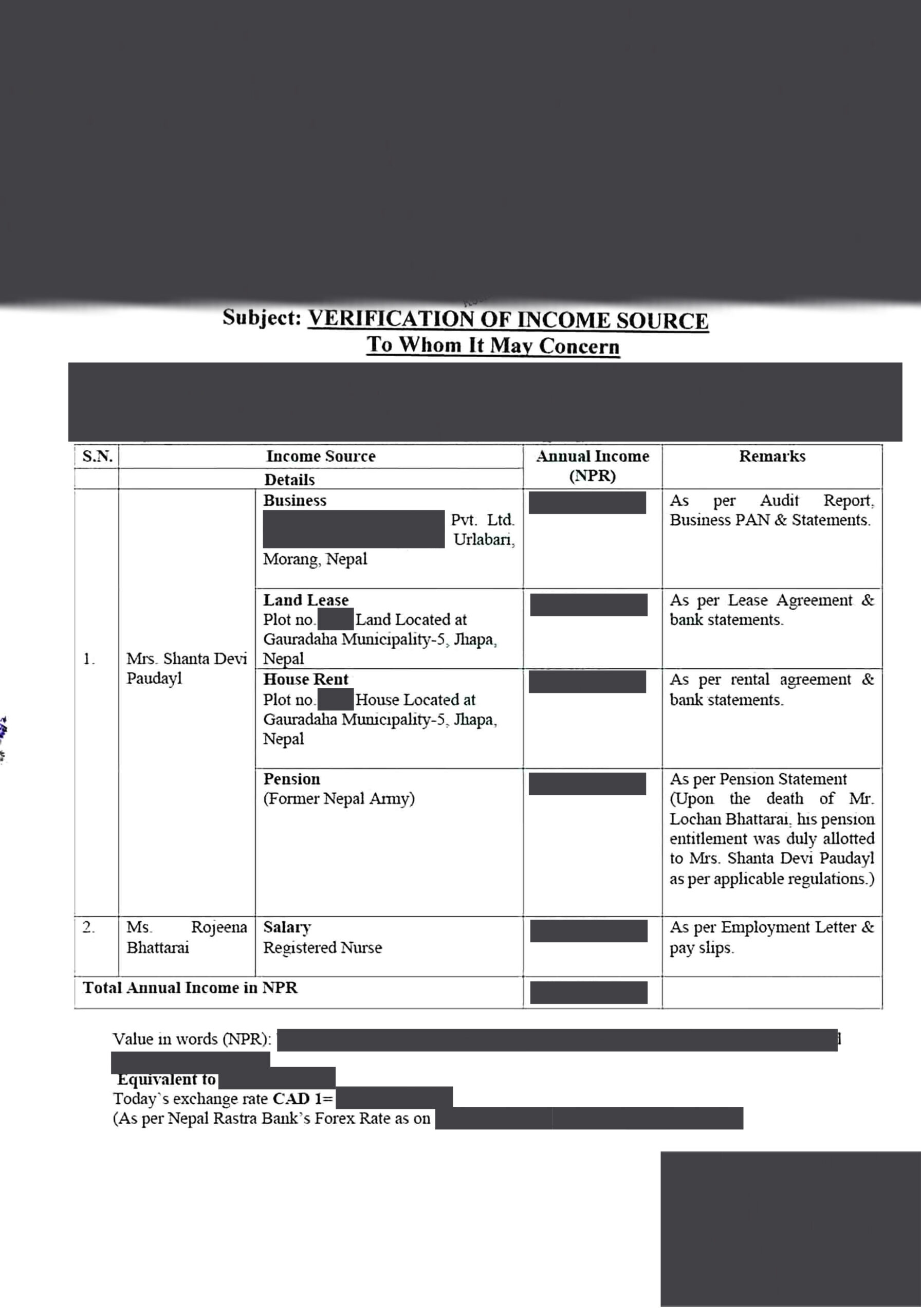
An Income Source Certificate is a document that confirms a sponsor’s source of income and, often, the estimated annual income, as verified by the local authority. Official municipality and rural municipality formats in Nepal indicate that this certificate is used to certify that a person has income from one or more sources and to state the total annual valuation of that income.
In simple terms, it tells the visa or education file this: your sponsor is earning money from real, identifiable sources. For students, this matters because embassies, visa officers, and universities may closely examine whether the sponsor’s financial background is believable, consistent, and well-documented.
For Nepali students, an Income Source Certificate is useful when the sponsor needs to show financial credibility. It helps explain the source of the sponsor’s funds and adds official local verification to the student’s financial background in the file.
This certificate can help:
Students should understand that the Income Source Certificate alone is usually not enough. It works as a supporting document, not a complete financial file by itself.
An Income Source Certificate can show income from salary, business, house rent, land lease, agriculture, pension, remittance, freelance or professional work, and other lawful sources of regular earnings.
Common income sources that may be reflected in the certificate include:
The documents required for an Income Source Certificate in Nepal can vary by ward or municipality. In most cases, the requested supporting documents depend on the type of income reported, so the exact list may differ from one applicant to another.
If your sponsor earns from a job, the file may include:
A salary certificate is often useful because it shows the employer name, role, and income details in a formal way.
If the sponsor owns a business, common supporting papers may include:
For business-related income, the ward office may request supporting documents, such as the business registration certificate and an audit report, to verify the source of income.
If the sponsor earns from renting out property, useful papers may include:
This is a very common case in study abroad files from Nepal because rental income often requires additional explanation. A rent agreement alone may look weak, but a rent agreement plus proof of ownership and a bank trail looks much stronger.
If the sponsor earns from leased land, the file may include:
This is especially useful when a sponsor is showing land-based income rather than salary-based income.
Agricultural income can be legitimate, but it usually requires careful documentation to ensure it appears traceable and consistent. If the sponsor earns from agriculture, the supporting papers may include:
If the sponsor receives a pension, useful documents may include:
For term deposits or interest-based income, the ward office may request a bank certificate or other banking documents to verify the source of income. In such cases, you may need:
If the sponsor earns abroad, the file may require:
To make an Income Source Certificate in Nepal, you should prepare the required supporting documents, visit your local ward office, submit an application for income verification, and collect the certificate after the ward checks and approves the details.
First, be clear about who the sponsor is and what income they are claiming. It could be your father, mother, brother, sister, guardian, spouse, or another sponsor allowed in your file.
Do not go to the ward office with only a request letter. Gather the papers that prove the income is real. This may include proof of salary, a rental agreement, business registration, tax documents, bank statements, or land documents.
Keep citizenship copies, relationship certificate if needed, and student-related admission papers ready.
The sponsor or applicant may need to visit the local ward office or, where available, complete the process through the municipality’s system. Some municipalities now offer proof-of-annual-income services on their online portals.
The office may check whether the income source is believable and properly documented.
If the document will be used for visa or university purposes, an English version is often more practical.
Before using the document, verify that the sponsor’s name, address, income amount, and relationship details match the rest of the file.
Ref. No.: ____________
Date: ____________
This is to certify that Mr./Mrs. [Full Name], [father/mother/spouse] of [Parent/Spouse Name], permanent resident of [Full Address], possesses the annual income from the following sources as per the documents presented in this office.
| S.N. | Source of Income | Schedule | Annual Income (NRS) |
| 1 | Income from Salary & Wages | 1 | 4,80,000.00 |
| 2 | House Rent Income | 2 | 3,60,000.00 |
| 3 | Business Income | 3 | 6,50,000.00 |
| 4 | Agricultural Income | 4 | 2,00,000.00 |
| 5 | Bank Interest Income | 5 | 75,000.00 |
| 6 | Pension Income | 6 | 1,20,000.00 |
| | Total NRS | | 18,85,000.00 |
| | AUDS | | 18000 |
Note: Exchange rate applied as per Nepal Rastra Bank on [Date], 1 AUD = NRS 104.
[Authorised Officer Name]
Executive Officer
[Municipality / Ward Office Name]
Office Seal
For study abroad, an Income Source Certificate should be used as one part of a complete and consistent financial file. Its purpose is to explain where the sponsor’s funds come from and to support the overall source of funds shown in the student visa application. The certificate works best when it matches the sponsor’s actual income type and is supported by clear evidence.
If the sponsor earns from house rent, the file should ideally include:
If the sponsor earns from business income, the file should ideally include:
If the sponsor earns from a salary, the file may include:
The Income Source Certificate should match the bank statements, tax records, ownership papers, business papers, and the sponsor’s written explanation. When all documents support the same financial story, the visa file looks clearer, more reliable, and believable.
Common mistakes include unsupported income claims, mismatched bank statements, incomplete documents, inconsistent sponsor details, missing translations, and using the certificate without proper supporting documentation.
A well-prepared income file can make your study abroad application look clearer, more consistent, and more believable. Get expert support to organize your sponsor documents properly and avoid mistakes that can weaken your financial case.
An Income Source Certificate in Nepal is generally issued by the local Ward Office of the applicant’s or sponsor’s Municipality or Rural Municipality.
Yes, it can, especially when the sponsor has mixed income sources, such as salary, business, rental income, or agricultural income, as long as each source is properly supported.
You can show income from salary, business, house rent, land lease, agriculture, pension, bank interest, remittance, and other lawful income sources.
Yes, it is commonly used to support the sponsor’s financial background in a study abroad file, especially when it matches the other financial and ownership documents.
Important guidance note
This page provides general guidance about studying abroad. Requirements, fees and policies can change. For advice about your situation, speak with a Goreto counsellor before applying.
Book Your Free Consultation
From choosing the right country to finding scholarships and housing, our counselors will guide you at every step.
Choose the right country based on your goals
Find courses that match your career plan
Get guidance on colleges and universities
Plan your finances, scholarships & part-time jobs
Plan your abroad stay & post-study plan

Schedule a free consultation with our expert counselors to discuss your study

Schedule a free consultation with our expert counselors to discuss your study