

Dhiraj Kandel
Managing DirectorSchedule a free consultation with our expert counselors to discuss your study
If you are planning to study abroad and you only have job experience to show, an Experience Letter can help prove your professional background. An Experience Letter is the most useful document when students applying abroad want to prove relevant work experience, justify a study gap, strengthen an MBA or career-focused course application, or make their application more credible.
For Nepalese students, an experience letter is especially important when applying to Australia, the UK, Canada, the USA, and Europe, where universities value a professional background that aligns with the chosen course.
An experience letter is an official document from your employer that confirms you worked in a specific role for a specific period. It mentions your job title, employment dates, duties, and work performance. This document matters most when your course has a professional angle, when you have a study gap, or when you want to show a stronger profile.
For a student applying abroad, the letter can help show:
Date: DD/MM/YYYY
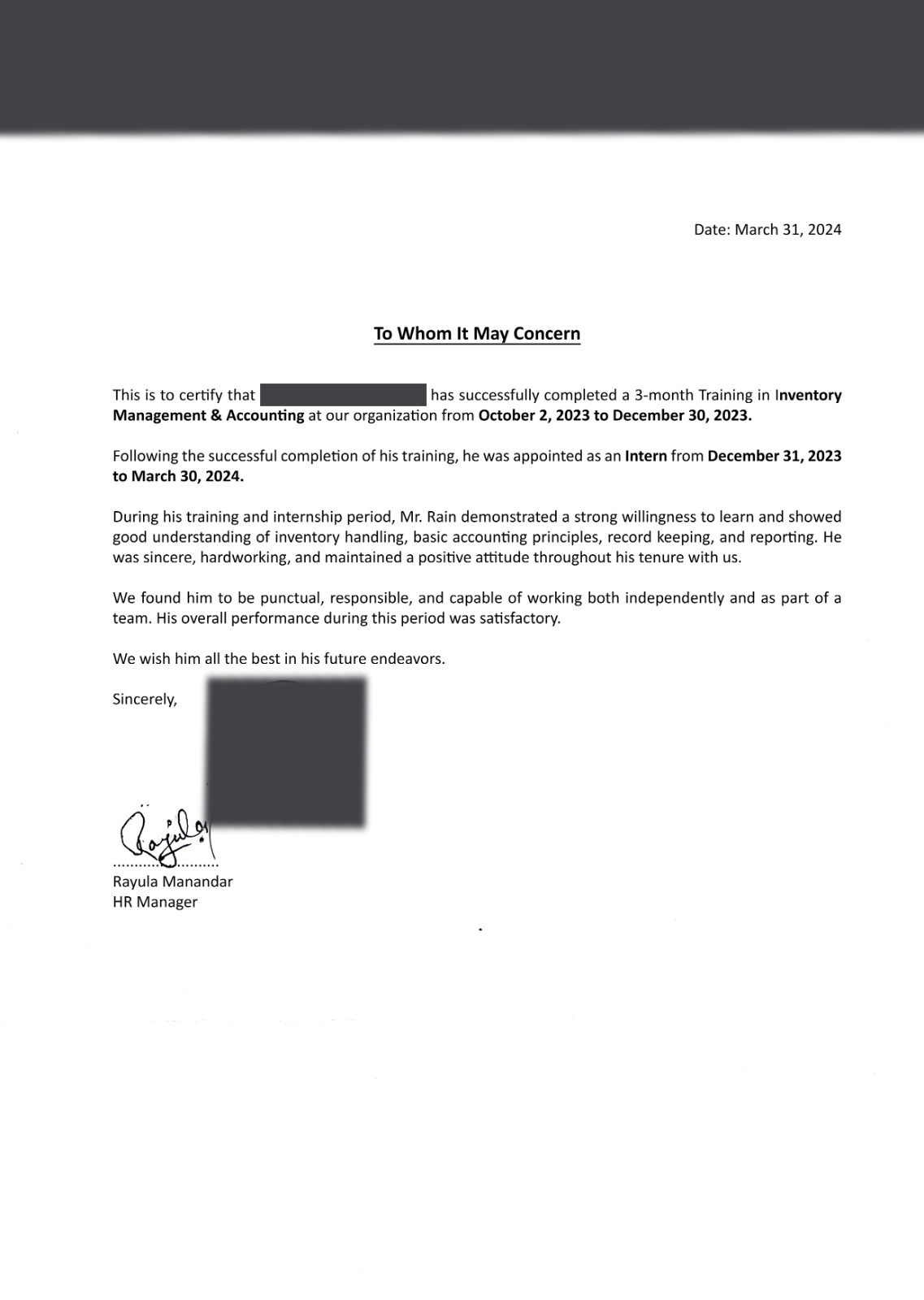
To Whom It May Concern
This is to certify that Mr. Ramesh Sharma, holder of Citizenship No. [XXXXXXXX] was employed at ABC Tech Solutions Pvt. Ltd., Kathmandu, Nepal, as a Junior Business Analyst from 15 July 2021 to 30 September 2023.
During his employment with our company, he was responsible for supporting business reporting, preparing data summaries, coordinating with internal teams, and assisting in project documentation and client communication. He performed his duties sincerely and maintained a professional attitude throughout his time with us.
We found him to be hardworking, disciplined, and committed to his responsibilities.
We wish him success in his future academic and professional endeavors.
Sincerely,
Sunita Karki
HR Manager
ABC Tech Solutions Pvt. Ltd.
Kathmandu, Nepal
Phone: +977-XXXXXXX
Email: xxxxx@abc.com
Date: DD/MM/YYYY
To Whom It May Concern
This is to confirm that Ms. Priya Adhikari has worked at Everest Data Services Pvt. Ltd., Lalitpur, Nepal, as a Data Analyst from 1 August 2022 to 31 December 2024.
During her employment, she was actively involved in collecting, cleaning, and analyzing business data, preparing weekly and monthly performance reports, identifying trends, and supporting decision-making for internal teams. She also worked closely with operations and marketing teams to organize data, prepare dashboards, and maintain reporting accuracy.
Throughout her tenure, she demonstrated good analytical ability, attention to detail, and a responsible approach to her work. She handled her assigned tasks professionally and contributed positively to the team.
This letter has been issued upon her request for further studies abroad and for whatever purpose it may serve.
Sincerely,
Rohit Shrestha
Operations Manager
Everest Data Services Pvt. Ltd.
Lalitpur, Nepal
Phone: +977-XXXXXXX
Email: xxxxx@everest.com
An experience letter detailing your work history is important for studying abroad because it provides universities and visa officers with clear evidence of your professional background before you apply. Even without salary details, it confirms your job role, employment period, and responsibilities, which helps make your academic journey look genuine, logical, and well-supported.
If you finished your bachelor’s and worked for 1–2 years before applying, an experience letter clearly shows where you worked, your role, how long you worked, and your main responsibilities. This helps universities see that your study gap was used productively for career growth rather than being left unexplained.
Your SOP explains what you did after graduation and why you are choosing a specific course. An experience letter serves as proof of those claims by confirming your job role, work period, and responsibilities, making your SOP more trustworthy and helping universities connect your professional background to your study plans.
This is especially important for programs like MBA, MS in IT, Data Analytics, Project Management, Public Health, and Engineering Management. If your previous job is related to the course you are applying for, the experience letter demonstrates that your decision to study abroad is grounded in real career progression and future goals, making your profile stronger and more relevant.
In countries such as Australia, Canada, and the UK, students may need to explain their work experience, career progression, and how their chosen course aligns with their future plans. A simple experience letter that highlights only work experience strengthens this explanation by clearly demonstrating your professional timeline and making your application more credible.
Many Nepali students worry that an experience letter without salary details may not be accepted, but in most study-abroad cases, salary is not the main focus. What matters more is proving that your employment was genuine, showing how long you worked, what your responsibilities were, and how the experience connects to your academic and career goals.
An experience letter becomes more powerful when combined with your CV, SOP, recommendation letters, transcripts, proof of internships, and portfolio. Together, these documents create a complete and believable student profile that gives universities and visa officers more confidence in your application.
An experience letter should include your full name, job title, company name, employment dates, key responsibilities, and an authorized signature on official company letterhead. For study abroad applications, these details are important because they verify your work history, support your SOP, and help universities understand your professional background.
A strong and acceptable experience letter should have:
To get an experience letter for study abroad, ask your employer or HR team for an official letter on company letterhead that mentions your job title, work period, and main responsibilities. Before using it in your application, make sure the dates, role, and other details match your CV, SOP, and supporting documents.
Before asking your employer, be clear about why you need the letter for study abroad. In most cases, the goal is to prove your employment history, role, dates, and sometimes your responsibilities, not to create a long recommendation letter.
Request the letter from your HR department, reporting manager, or another authorized person in the company. This helps ensure the letter is official and easier for universities or visa officers to trust.
Ask them to mention your full name, job title, department or function, employment start and end dates, and key responsibilities. If you are still working there, ask them to use “Present” instead of an end date.
A strong experience letter should be printed on the company letterhead and signed and dated. While this is especially explicit in university guidance for formal references, the same authenticity signals make employment documents more credible and easier to verify.
The letter should include the name and designation of the authorized signer, and ideally, the company seal or stamp if the company uses one. Contact details are also helpful because they make the document look more complete and verifiable.
Before you use the letter, verify that the job title, dates, spelling of your name, and responsibilities match your CV, SOP, LinkedIn profile, and other application documents. Small inconsistencies can make your application look weak or confusing. This is a practical best practice based on how such documents are used to validate your profile.
Request a signed PDF scan and, if possible, a hard copy. That makes it easier to upload during university applications, visa documentation, or counselor review.
To ensure you get a good job experience letter, request it early from the right person and clearly tell them what it needs to include. Before using it, make sure the letter is official, signed, accurate, and consistent with the rest of your study abroad documents.
Don’t let bad documentation ruin your study abroad dreams. Education counselors can help you review your documents and ensure your experience letter, SOP, and CV align properly before you apply. The right guidance can make your application look more complete and trustworthy.
The best type of experience letter for study abroad is a simple employer-issued letter that clearly mentions your job title, work period, and main responsibilities. This format is useful because it proves your work history without adding unnecessary details.
Yes, an experience letter is important for MBA and career-focused courses because it demonstrates how your academic plans align with your professional background. It can make your profile look more relevant and support your career progression story.
Yes, an experience letter gives clear proof of your employment history, job role, and career timeline. This can make your study abroad application look more genuine and better explained.
An experience letter primarily confirms where you worked, your role, and your employment period, while a recommendation letter focuses more on your skills, character, and overall performance. For study abroad, both can be useful, but they serve different purposes.
A strong experience letter should be clear, official, and easy to verify. It should be on company letterhead and include your correct job title, work dates, responsibilities, and the signature of an authorized person.
From choosing the right country to finding scholarships and housing — our counselors will guide you at every step.
Choose the right country based on your goals
Find courses that match your career plan
Get guidance on colleges and universities
Plan your finances, scholarships & part-time jobs
Plan your abroad stay & post-study plan

Schedule a free consultation with our expert counselors to discuss your study

Schedule a free consultation with our expert counselors to discuss your study